Hatbrott – normer, begrepp och lagstiftning
7 november 2015 | In Uncategorized | Comments?Föreläsning från Filosofiska Föreningen i Göteborg, februari, 2015
https://soundcloud.com/david-brax-1/hatbrott-normer-begrepp-och-lagstiftning
Reparationsargumentet för kvotering av kvinnor i bolagsstyrelser
8 mars 2015 | In Uncategorized | Comments?Den 8/3 diskuteras kvotering i filosofiska rummet. Gäster är Sofia Nerbrand, Annika Gilljam och jag. Annika har skrivit sin kandidatuppsats om ett argument som ofta glöms bort när vi pratar om kvotering: reparationsargumentet. Eftersom filosofiska institutionens arkiv av uppsatser ligger nere för tillfället har jag fått Annikas tillstånd att lägga upp den här.
Kvinnlig Reparation – kan kvotering av kvinnor berättigas utifrån reparationsprincipen?
On caricatures, freedom and the nature of assholes
13 januari 2015 | In Comedy Emotion theory Ethics Hate Crime media Moral philosophy Philosophy of Law politics Psychology Psychopathy Self-indulgence Uncategorized | Comments?I have to admit, I’m not overly fond of caricatures. Never have been. I guess sometimes they manage, just like a good metaphor does, to capture something important about its object that was not as obvious before. The thing that a caricature brings out about the object is usually intended to render it ridiculous. Most things are partly ridiculous, of course, it’s almost never a useless way of viewing a thing. But it becomes particularly useful if the thing, or person, or group, is in power, is pompous, is revered to an unreasonable extent. It becomes less so, even harmful, if the thing or person, or group, is already despised, disenfranchised, already treated as ridiculous.
The reason why I’m not overly fond of caricatures, or metaphors for that matter, is that they rely on putting emphasis on certain things at the expense of other things, and the result, the ”translation”, as it were, depends on whether that serves to correct the received view in order to reflect the actual importance of those things. Caricatures have a history of ridiculing power, and that history is well-rehearsed these days. But they also have a history of serving power. Of dehumanizing people it deems of less importance, which makes those people even easier to disregard, or even to kill.
There is an argument that says that we have freedom of speech in order to protect precisely the sort of statements that we do not like. This is spurious. It may be true that the extent of freedom of speech can be measured by exactly how offensive, vitriolic, hateful, debasing, threatening expressions that it allows, but it hardly seems to be the point of having freedom of speech. Some people will say that freedom is a value in itself. Others, like the more often quoted than read J.S. Mill, say that freedom of speech is an instrumental value, which serves a function. And it can be limited when it fails to serve that value. On this account, we can say that freedom of speech is a matter of costs and benefits. The offensive can occasionally be a benefit, the hateful very rarely is, but we may want to preserve the right to make hateful assertions because the total value of relatively unregulated speech is positive. The benefits may outweigh the costs. (It should be noted that this analysis could, and, I believe, should, adjust for fairness. If the costs and benefits are unfairly distributed so that the worst off bears the greatest burden, the cost may be unacceptable even if it is outweighed in absolute terms). Hate speech laws tend to draw a line between the offensive (which is allowed) and the hateful (which is not), but some legal scholars and a lot of libertarians believe this distinction fail to track anything of moral importance.
Now. In moral philosophy, the notion of an asshole is quickly turning into a technical notion of considerable use. An asshole is a person that does not infringe on other peoples rights, but does everything he/she can to reap the benefits for him/herself, and nothing to help others. It is the kind of person that uses freedom of speech to say all the worst things he/she is allowed to, while contributing nothing to a worthwhile discussion. The behavior of such people tend to be on the cost side in the cost/benefit analysis of a right. Assholes are on the cost side, and when they become too many, the instrumental value of certain freedoms decreases. At the same time, the fact that we tolerate them (even encourage them in certain contexts) may be a testament to the strength of our society, our resilience. Assholes also serve the considerable function of demonstrating the gaps in our systems and institutions.
I’m going somewhere with this. I have not made myself familiar with the works of Charlie Hebdo. I don’t know french, and I’m not sufficiently familiar with the cultural and political context. If I understand things correctly, their tendency has been to make fun (if that is the right word) of power and pompousness in all it’s guises. It certainly is no straightforward instrument of power. But equal treatment does not amount to equal effects, especially when the people and groups treated have different social standings to begin with. Some of their work may render things ridiculous that we all benefit by viewing in that light. Some of it may serve to dehumanize and ridicule people that are already being discriminated against, whose social standing in the context is low. The latter is an unmitigated cost, and it is the work of assholes, in the technical sense described above. Caricaturists will often tend towards asshole-hood. And it is possible that they should, that it is for the good that there are people, and publications, like that. But it would probably be unbearable if we were all like that. And while the extent of free speech may be measured by the worst things it allows, the value of it must be measured by the best things it allows that would otherwise have been banned.
The Pallas Athena Complex
7 januari 2014 | In Uncategorized | Comments?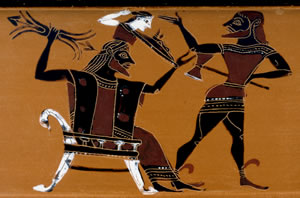
So you write something and maybe it’s a good thing. You’re new so what do you know? You’re still working things out, but you have been doing that for a while so you’ve got this idea that maybe you should have presented it, or something else, by now. And you want to make a good first impression. You would like it to be the case that the time, whatever the time, it has taken you to write this thing has all been worth it because it’s basically flawless. Like Pallas Athena, it should spring out of your head fully ready to do combat on it’s own. Maybe you fear criticism, so you want there to be very little space for it – the text should be laden with defenses for anything the reader could conjure up. So you work through it again and it’s impossible because the time it takes you to work through it, whatever the time, means the result must be even better than when you started working through it, and odds are you have reached the point where you’re not improving it, you’re making it worse. Time spent with a text can make you blind to how it reads for a new reader, you can’t help reading into it things that are not publicly available. It shouldn’t be this hard, or so you say (conveniently forgetting that Thomas Mann thing that a writer is someone for whom writing is more difficult than it is for other people).
What I’m describing to you is what I like to call the ”Pallas Athena Complex” and I believe it is responsible for academic failure to a far greater extent than lack of academic talent is. It means tons of promising work remains hidden in drawers and may never see the light of day. It’s a form of shyness, of course. The reluctance to appear vulnerable, or responsible for something flawed. But it’s also a byproduct of the cult of the solitary genius. Particularly susceptible to belief in this cult are those who approached their subject on their own, and where taught the history of their subject by description of the work of eminent singular persons. Particularly susceptible to the Pallas Athena Complex are those who, however confident, lack confidence in the readers ability to spot promise in a text.
If you’re a teacher or a supervisor, you should learn to spot the early signs of the Pallas Athena Complex. Broken deadlines, postponed seminars, general avoidance despite keen interests. If you’re a sufferer, go to seminars and conferences an take note that people are submitting stuff that are much worse than the stuff you’ve got hidden away. And start a blog, you don’t even have to provide footnotes in a blogpost.
The limitations of the ’more speech’ solution
30 november 2012 | In Crime Hate Crime media Moral philosophy politics Uncategorized | Comments?On the 25th of november the youth wing of the swedish social democratic party held an action they called ”nätfight” (”net-fight”). The idea was, for this day at least, not to let all the xenophobic nonsense that flourish on various internet fora to stand unopposed. Arguments were to be made. It’s a ”take back the internet from the Trolls” kind of initiative. Most non-xenophobic people dislike engaging in these conversations (especially those that have tried without result) as very little good is likely to come out of such an engagement. Perhaps we believe that engaging will only make things worse. Xenophobic views are not primarily based on arguments, and are unlikely to disappear or be made more moderate on the basis of argument.
This action is similar in idea, but different in content, to two other recent attempts to counter the dark sides internet. The first was launched by a swedish journalist and involves ”love bombing” of sites and Facebook pages where young people are subjected to bullying. The other started with the #signyosonisgay hashtag, which started as a homophobic method of ridicule, but was turned into a medium to show love and support for homosexuals.
The first initiative is based on argument, the other two is based on ”crowding out” bullying and xenophobia. But they have one central feature in common: they are based on the idea that the harm being done in the name of free speech (especially on the internet) is effectively countered by more speech.
Some will say this is the ONLY acceptable way to counter harms done via speech. The ”more speech” solution is preferable to regulation of speech – it’s results outperform in every regard, or so goes the argument. It’s more effective in discouraging harmful speech, it empowers the victims of such speech by demonstrating that both the arguments and other people are on their side, and it does not threaten free speech (and we should be reluctant to equip authorities with the means to restrict speech).
There’s no question that ”more speech” is for the most part a good solution. But the reasoning applies to almost any cause of harm: we should alert the police when we see an assault taking place but we should also intervene. Intervention, when possible, is often more effective on the precise same grounds. But should such a duty, and such initiative, replace the police and laws? Surely not.
Even if the ”more speech”, and ”intervention”, solution, is effective when active, it is basically unfair. It only protects those with friends or advocates active and good enough to make enough of a difference. The law exist, or should exist, to provide protection for those who are not protected by such resources, those who are not currently popular. To argue that ”more speech” should replace hate speech laws is similar to a rich person saying that the police is not needed when one may as well hire body guards.
The other reason is that, as stated above, evidence suggest that xenophobia is not based on argument, and thus will not disappear by argument. Arguments are effective in other ways, by strengthen the victim, and the victims advocate, but it is unlikely to deter the assailant. Criminal sanctions have the benefit of providing reasons to desist no matter whether you accept the argument or not. This, to, is the rationale behind the two non-reasons based initiatives above. Even if you cannot persuade the haters to stop, you may crowd them out, you can bore them and limit the impact of their statements.
But there’s nothing to suggest that these effects would be lessened by the presence of a hate speech law.
Further issues concerning hate and harm
22 augusti 2012 | In Uncategorized | Comments?In his influential 2008 book ”Hate Crime and the City” (the City is London, and there is no further structural or thematic similarities to the HBO series) Paul Iganski provides an excellent interdisciplinary account of hate crime. I will now do something very mean spirited to it: I’ll pick a single sentence – sentence FRAGMENT – out of its context and tell you that what’s wrong with it illustrates one serious flaw in the ”hate debate” (Incidentally the title of another volume, edited by Iganski. It too has an interesting single flaw. I’ll get back to it.) Here it is:
…however, what distinguishes ’hate crime’ from other types of crime is that all ’hate crimes’ generally hurt more than parallel crimes.
As previously mentioned, Iganski has provided evidence to the effect that hate crimes tend to hurt more than similar but otherwise motivated crimes. But that’s not what this sentence says: It says that ALL hate crimes GENERALLY hurt more. The ”All” is superfluous or misleading, and offsets the important qualification that hate crimes GENERALLY, but not always, hurt more than parallel crimes.
But the ”all” is not really an innocent typo: it carries the weight of the claim that this is what DISTINGUISHES hate crimes from parallel crimes. Of course it isn’t. In order for the claim to be made that one type of crime causes more harm than another there must ALREADY be a distinction of types. Otherwise, ’hate crime’ would be the class of crimes that tend to hurt more than parallel crimes, and then ’hate crime’ is a fantastic misnomer. And if ’hate crimes’ would be distinguished by tending to cause more harm, then the claim that they tend to cause more harm carries no information.
Iganski intends to provide a victim-centered conceptualization of hate crime, that’s why impact matters and should be part of the ’hate crime’ function. But then something else is needed, a specific ”kind” of harm, say, that’s only contingently (but strongly) related to hate motivated crimes. But then we need more illumination: Is there such a typology of harms, and what is it’s normative significance?
As mentioned earlier in these posts, there is no problem justifying blanket punishment enhancement for types of crimes on the basis of their contingent propensity to cause harm. The distinguishing mark, however, should lie elsewhere.
Rather then positing a type of harm, a ”victim centered approach” of hate crime could, and should, take an indirect route: via the victims perception of the motivation of the offender and/or content of the offense. This makes more conceptual sense, as almost all formulations (’hate’, ’bias’, ’hostility’ crimes) does focus on the mental state of the offender as the distinguishing feature.
Punishing causes
3 januari 2012 | In Crime Ethics Hate Crime Moral philosophy Moral Psychology Uncategorized | Comments?”Tough on crime, tough on the causes of crime”, remember? I remember very little of the substantive debate but I do remember that it spurned a debate on the use of non-committing slogans in political speech. The immediate appeal of slogans should not be dismissed as a mere trick, however.
There is a quite obvious and quite relevant issue hidden in the slogan: How does, or should, our approach to crime relate to our understanding of, and approach to, the causes of crime? Presumably our toughness or softness on crime should be modulated on the basis of our perception of the causes in question because clearly, all crimes do not share causal histories and clearly, this matters to how we assign responsibility.
Quite generally, causes are relevant to responsibility and to criminal punishment as punishment is meted out on basis of, and in proportion to, the harm agents cause. A highly valid defense to the allegation of murder is to say that you didn’t cause the person to die. Or, actually, accurately and more precisely: that you didn’t do it. To murder someone is not only to cause the death of another, but to do so while trying to do so.
The most obvious causal component of relevance to responsibility/culpability is the decision. We are condemned for the things we decide to do, and decisions have consequences. Reasons and considerations are presented to us, or thought up by us, and then we make a decision to act on some of them. We are then held responsible for at least the causal consequences that we had reason to believe would follow. But decisions are not where causal chains end. And while deciding to do something that will cause harm when there is no reasonable amount of compensation is surely blameworthy in it’s most paradigmatic form, it’s not the end of blameworthiness either.
Yet, there are further moral judgments to be made which goes beyond the decision. For instance: what considerations did you act on? How was the case for and against acting presented to you? Was it greed? Was it vengeance? And now the question becomes: can we add to a criminal sentence on the basis of pre-decision causes? We seem to be able to subtract from a sentence on basis of certain causal pre-cursors, such as ignorance or a mental episode. But can we add?
Now to the hate crime context. For theoretical reasons as well as practical ones further down the line, it’s important to distinguish between the reasons for the support of hate crime legislation and the justification of that legislation. My reasons to favor higher taxes may be that I would gain from it in the long run, but that’s not sufficient as justification as tax rates are not in place to satisfy my interests. It does mean, however, that I’m more likely to look for, and find, further reasons for higher taxes.
It’s very likely that support for hate crime legislation is at least in part grounded in the intuition that some pre-decision causes are worse than others. We dislike, and we are right to dislike, prejudices, vengefulness, greed etc. But it is not clear that we should punish on the basis of the moral objectionableness of pre-decision causes. Even when we are somehow responsible for having become bad people, we can’t be punished for being bad people, only for doing what bad people tend to do, and which makes them bad: harm. If there are other justifications, we should identify them. But we should be very clear that our acceptance of those justifications is not wholly founded in our independent, warranted, but legally invalid, moral stance. Or, of course, we must make the case that these pre-decision causes are reasonable grounds for punishment enhancement. Which means much more work.
Two lessons to draw from this:
1)We may maintain that decisions are where culpability starts, but that the picture is more complex then previously recognized. Decisions may be judged as worse not only on the basis of the harm intended, caused or risked, but on the considerations that was deemed sufficient for the decision to be made. To treat a prejudiced view as a decisive reason, then, is worse, for instance, than treating greed as such a reason because it is a worse reasons. Still, we are not punished for this reasons, but for treating it as a decisive reasons. (Leaving, for know, the question whether the cause and/or reason for our accepting this consideration as a (decisive) reason should influence the extent to which we are culpable…)
2) Pre-decision causes are clearly relevant for effective preventive measures. We should concentrate a lot of effort at counteracting them and the most effective means may not be punishment enhancement, or any other means available to the criminal law.
Being ”tough” on causes of crime doesn’t necessarily, or primarily, involve punishing people for having certain beliefs attitudes or dispositions, but effectively counteracting the conditions under which such beliefs, attitudes or dispositions arise.
There goes the neighbourhood
21 december 2011 | In Crime Ethics Hate Crime politics Psychology Uncategorized | Comments?
What counts as a hate crime?
Among the first questions you should ask when being introduced to a new category-concept is this: what does it cover? What qualifies as an ”X”? When given a fairly informative definition, you then quickly go on to fringe cases, and ask whether they qualify or not. This technique will make you seem polemic and lacking in seriousness. If you’re a decent philosopher, that’s at least partly true.
We need fringe cases in order to lure out the differences between theoretical models, and also to test the plausibility of these models.
Hate crimes, as we know, invoke a combination of factors, mainly crime, prejudice and the small but very significant and problematic notion of ”because of”. A crime is a hate one when it is committed because of a prejudice against a certain group (membership in which is based on some to-be-determined characteristic important to the victims’s, or somebody’s ”identity).
Now, it’s important to note that committing a crime because of a prejudice against a group, is more narrow than committing a crime because of group membership. I may believe (rightly) that the elderly are less able to catch me, running from the scene of the crime, and therefore target them. According to the so called ”victim selection model” for hate crimes, this might qualify simply because group mebership was part of the reason why I picked out this particular victim. According to the animus-model, it wouldn’t count unless I also held some negative and unfounded views about the elderly and that was part of the motivation for the crime.
The victim selection model allows for cases where the perpetrator has no prejudice, and prejudices in general do not enter the explanation why the crime took place. Semantically, this puts the label ”hate (and bias) crime” in question. But consider a further case:
A person assaults a group of immigrants that have recently moved in to the neighbourhood. The reason is that he/she (rightly) thinks that the arrival of immigrants have lowered the economic value of his/her house, and thus intend to scare them into moving away. Let’s imagine this is the sole reason, and the perpetrator can deny any prejudice by saying that he/she would’ve assaulted anyone whose presence in the neighbourhood had that effect.
What does the animus model say? Well, no animus is present, so this seem not to be a hate crime. The victim selection model, on the other hand, would presumably rule it in.
However: the peculiar feature of this case is that the crime is still committed because of prejudice. It’s just not the prejudice of the perpetrator, but that of the potential byers of property. On one interpretation of the ”because of” clause in the hate crime definition, then, these sorts of crimes would count. In many respects, these crimes seem to be at least as shady, and in some sense cowardly, as crimes committed on the basis of a prejudice that you have yourself. They presumably do as much damage. But should they count as hate crimes?
It depends, you might say (and rightly so), on the proper analysis of the
because of
. It’s just that this analysis depends on the plausibility of what’s included, like the fringe case above. And that in turn depends on the moral foundations of hate crime legislation. A question that, as reader of this blog may have noticed, is far from settled.
E.B White with the benefits of hindsight
21 juni 2011 | In Uncategorized | Comments?Almost shockingly, E.B. White’s essay ”Here is New York” takes a turn to the macabre. Published in 1949, the following passage strikes the reader as remarkably contemporary:
”The subtlest change in New York is something people don’t speak much about but that’s in everyone’s mind. The city, for the first time in its long history, is destructible. A single flight of planes no bigger than a wedge of geese can quickly end this island fantasy, burn the towers, crumble the bridges, turn the underground passages into lethal chambers, cremate the millions. The intimation of mortality is part of New York now: in the sound of jets overhead, in the black headlined of the latest edition”
It continues:
”All dwellers in cities must live with the stubborn fact of annihiliation; in New York the fact is somewhat more concentrated because of the concentration of the city itself, and because, of all targets, New York has a certain clear priority. In the mind of whatever perverted dreamer who might loosethe lightning, New York must hold a steady, irrestible charm.”
The WTC not being conceived of yet, White thought the likely target to be the soon to be raised United Nations building.
Raisin a hedonist
16 december 2010 | In Uncategorized | 1 Comment
Like most people with children, I want my child to be happy. Of course, being a hedonist, I think it would be great if all people could be as happy as possible, but I’ve got a particular interest in this one. That is: I want his experiences to be mostly positive. I don’t want him to get everything that he wants, because, like his dad and most other people, he is likely to sometimes want stupid things. I don’t want him never to be sad or disappointed, because those things seem essential to learning to cope, and learning to cope seems to be essential to becoming a happy person. (Of course, could it be done without the sadness or disappointment, that would be preferable, and perhaps some die-hard optimists are like that. It’s just important that one nevertheless learns to understand sadness and disappointment, to be able to recognize it in others).
Being brought up by a hedonist is probably not as immediatly and obviously fun as you might imagine.
Here come the raisins: Most toddlers like raisins. Eating them, as well as handling them, is clearly pleasant. So, being a hedonist, and wanting my son to have pleasant experiences, it seems obvious that I should feed him raisins. And so I did.
But raisins are an option now. The hedonic adaptation is extremely quick in these kind of cases. A few raisins in and he is eating them in the kind of semi-consciuos way the American Stereotype eats pop-corn while watching a movie. Suddenly, not eating raisins right now is unpleasant, and totally out of proportion to how pleasant it was to eat them earlier. The net gain of introducing a new, but finite, source of pleasure may actually be in the negative.
To paraphrase Nietzsche (is it?): if there are raisins, how could I live with not eating raisins?