Hi Blog, it’s me David
28 augusti 2011 | In Meta-philosophy parenting Psychology Self-indulgence | Comments?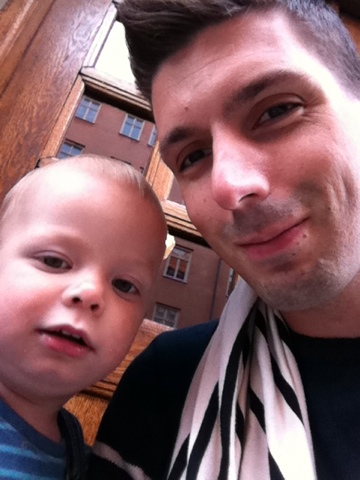
Most blogs are abandoned within a year, according to statistics that I just made up. Due to distractions, lack of readers or time, or just the failure to make blogging part of the unforced everyday writing that just sort of happens in a writing person’s life. The sort of writing that doesn’t take more time than it does to read it. Just thinking in a slightly more public medium.
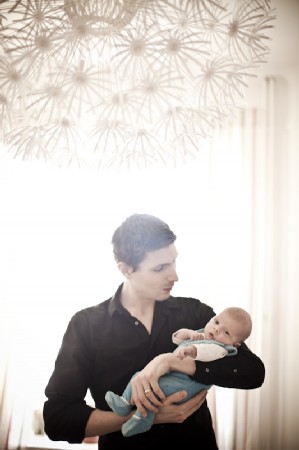
What I’m saying is that I intend to, and kind of think I ought to. Just not when it competes with the much superior activity of hanging with this guy.
Morality begins
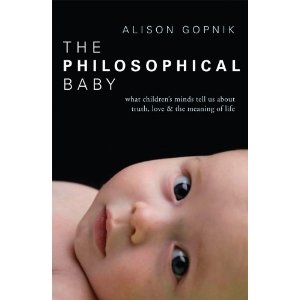
5 januari 2011 | In Books Emotion theory Moral Psychology Naturalism parenting Psychology | 3 CommentsDevelopmental issues in general have, for obvious reasons, been much on my mind lately. It strikes me, as it struck Alison Gopnik thus causing the book the philosophical baby to be written, as strange that the importance of the development of certain capabilities, such as morality, belief-acquisition, language, understanding of objects and other persons, has not been seriously attended to in the theories of those things. Surely, a proper understanding of any domain needs to involve an understanding of how we come to know about it. The cognitive operations that the adult mind is capable of didn’t start out that way, and part of solving the mysteries of cognition is to investigate how it got that way. As Gopnik pointed out in her earlier book the scientist in the crib, babies learn in the way science proceed: by testing hypotheses, revising previous concepts and explanations to fit with the facts, and by thinking up new experiments. We start out with very little, but not nothing, and then we build on that. People generally start out the same – babies everywhere can learn whatever language, but at some point, when we’ve found what sorts of sounds typically occur in communication, we start to interpret, and eventually to ignore small vocal nuances in favor of more effective and more charitable interpretation within the language we thus acquire.
Understanding development is important in itself, and for understanding what it is that thus developed, but it is also important for treatment. If we know how certain capabilities develop, we might understand what happens when they don’t.
But here comes the first kink: scientist disagree about a key feature of development: whether we actually learn ”the hard way”, or whether certain developmental stages, such as understanding that others may have different beliefs from us, just ”kick in” at a certain age. Some knowledge may develop, not like conscious, or even non-conscious, belief-revision, but like facial hair or breasts. Presumably, these things start due to some biological signal, too, but it seems to be a different process from the sort of learning involved in science. It is also possible that the ”signal” in question must appear at a certain window of time. The intense developmental period known as childhood doesn’t last forever. For instance, if you cover the eyes of a cat from birth until a certain time, it wont develop eyesight at all.
These things are even more important in the case of treatment. If I fail to develop certain forms of understanding, such as understanding false beliefs, it is very important whether I can learn to understand it, or whether I need the biological signal. And, of course, whether this biological signal can be provided later on, or if it is too late.
Understanding these features when it comes to morality is clearly of immense interest. How does morality develop? We often hear that children can distinguish between moral and conventional rules at the age of 2 1/2 – 3. But how does this happen? How does one learn the difference? Clearly, we are born with a sense of good and bad (as I’ve argued, this is the capacity to feel pleasure and displeasure, and certain objects and situations that cue these feelings), and with the early stages of social neediness. From this, arguably, morality is created. But how? Is it just the persistent association of the needs/desires/interests of others with hedonic reaction in oneself? Or is it a further developmental stage that is needed?
This is a crucial thing, if we want to understand and do something about immorality. Immorality may, of course, arise in many ways. It may not have been nurtured, so that the right association wasn’t made in the crucial developmental window. But it may also be that the mechanism didn’t kick in, due to some cognitive disorder. And finally, there are cases where the moral reaction is just outnumbered by other interests: morality isn’t all of evaluative motivation. Which of these is the origin of a certain immoral act or immoral person is of immense interest when it comes to treatment, and also when it comes to assigning responsibility.
The Science of Sleep
1 december 2010 | In parenting Psychology Self-indulgence | Comments?
Background
A few years back when, driving my supervisors to despair, I suddenly became interested in everything, I did some semi-serious reading about sleep. Sleep, it turned out, is poorly understood. There are a lot of theories, but nothing much solid, about the function of sleep and how that function is carried out. Memories are consolidated during sleep, that much seems clear, meaning that if you’re in an information-heavy line of work, taking the occasional nap is probably a good idea. The need for sleep seems obvious. Of course we need to ”recover”. We get tired in the same sense that we get hungry, i.e. via a bodily feeling that reminds us that something needs to be done. But this ”of course” carries little actual content. WHY do we need to sleep? What is this recovering all about? And could it be done in another way? If it is something that needs to be replenished, couldn’t this be done artificially, and quicker?
During the more intense period of writing in my life, I’ve been nearly angry with the need to sleep. Don’t get me wrong: I love sleeping. That is, I love the fringe bits of it. The beginning and the end, basically. The unconscious part, I could do without (or could I? That’s what I want to find out).
Sure, there is something, well, relaxing about the fact that everyone powers down for 6-8 hours a day. I guess it keeps the general pace down and that, at least, seems sort of desirable. But some more thorough counter-factual thinking needs to be done about what would happen if we got rid of the need to sleep. The necessity of shelter would probably be less of an issue, for instance, which would make more diverse lifestyles possible. Having a home, and a fixed address, would become (more) optional. Society would crumble, or flourish, or both.
To the point
Having been a practicing parent for almost a year now, sleep – and the lack of it – has once again become a central topic. Why does the baby refuse to sleep for more than an hour, and what should we do to make things better? There are recommendations and, as so often in this neck of the woods, the recommendations are contradictory. Don’t pick the baby up. Do pick the baby up. Comfort. Don’t comfort. You’ll make the baby insecure if you don’t. You’ll make the baby dependent if you do. And so on. In the advice literature, almost regardless of the topic, there is a gap between what science says and what the experience of experienced parents tells. The situation is not made better by the fact that the science in this domain is, like its main subject matter, in its infancy. And even if the science of sleep where in a better state, it’s not always the case that understanding a phenomena leads to a way of coping with it.
Sleeping babies are, in two distinct ways, just barely the domain of psychology. First: sleeping is, mostly, an unconscious process. It’s as much a matter for physiology, neurology, biology and chemistry, as it is for psychology. Second: babies are in the process of becoming fit subjects for (folk) psychology proper. We don’t quite get them, since our reasons for poor sleep (chili eaten late, result of funding application due tomorrow) are not theirs. Nevertheless, the interaction we have with our kids is very much a psychological affair, and its almost impossible not to psychologize the explanations we use in such interactions. We even do it with computers, for crying out loud.
The contradictory advice currently given is that it is important with habits: the same procedure every night. But also: you must experiment with conditions, to find what’s right for you and your baby. As luck would have it, I’ve got a few months to figure it out.
Parenting and the end of ethics
28 november 2010 | In Meta-ethics Meta-philosophy parenting Psychology Self-indulgence Uncategorized | Comments?So ethics month(s) just ended. On Thursday, I sent around 50 critically acclaimed essays on applied, normative and meta-ethics back to their authors. Leaving me pondering the proposition that there is now a group of people, the sort of university educated people that invariably turn out ruling the world, the media, the arts and so on, that I taught ethics. For future readers of the web-archives: I’m sorry. Alternatively: You’re welcome.
Normatively, they are all over the place. Utilitarianism is probably the strongest contender, but not by a majority vote. Meta-ethically the interest has a clear tendency towards epistemology, and a weaker tendency towards coherentism. In general, they are very much able to relate their moral judgements in particular cases not only to the normative theory they favor, but also to other theories they know are held by other people. Let’s go out on a limb and call it a good thing.
Those propositions are now passed on to you, as I turn my attention to other things, assuming other perspectives. I’m on parental leave. My main objective for the next few months is play. There will be drumming, there will be crawling and toddling, there will be incomprehensible talk and the provision of feedback. There will, in all likelihood, be a sharp decline in vocabulary, grammar and level of abstraction in the blog posts to come.
A rare venture into politics
21 september 2010 | In Moral Psychology parenting politics Psychology Self-indulgence | Comments?I have little or no business pretending to be initiated about politics, but here is what seems to me to be at issue in this latest election of ours:
A party with a shady past (and present) characterized by their policy to restrict immigration just made it into the parliament, getting 5,7 % of the votes. Because we (probably, not all the votes are in yet) have a minority government, this party can influence what mixture of left- and right-wing decisions gets made (but not the budget, mind). The only way to get their own points across, however, is to strike some sort of deal with the other parties. And those parties probably won’t, or they will loose all credibility. On the issues on which it’s really important that this party doesn’t have a say, they face roughly 94,3% opposition. With a parenting-analogy: they may influence what pyjamas to wear, but not whether or not to go to bed.
The party in question seems to believe that a lot of people think like they do, and want what they want, but can’t, yet, bring them selves to vote for them. The campaigns that started around the time of the election (a bit to late) are mostly about this: stating in no uncertain terms that, no, we don’t think or want what they think and want. Emphatically so. It’s not just that their politics differ on certain issues from the policy we happen to habitually support. It’s not just that we disagree about the most effective route to some common political goal. We really, truly, disagree with their views. In particular, I think, we hold that the relevant factor is not what happens to our standard of living when immigrants arrive (some of us believe that this increases, when you count properly), but what happens to theirs.
Conservatives and Socialists in this country disagree to, of course. They disagree on how people (and, consequentially, the economy) basically work. The differences in social policies is the main expression of this. But the differences seem, here at least, to be one in degree, not in kind. We disagree a bit about about how motivation and incentive works, and how the unemployed, sick and needing should be helped. Most of these differences, then, seem to regard (psychological) facts and not, really, morals, and just barely that strange in-between-beast ideology. (While it does smack of morals when you say that someone should just ”snap out of it”, the underlying question of fact is whether they can). Few people hit the streets to tell the conservatives that, say, the schools should not start grading kids earlier, because that has little or destructive effect on performance and development, or that unemployed people shouldn’t be forced into demeaning jobs, but should be given the opportunity to develop worthwhile skills in pretty much their own time. One reason we don’t often hit the street with these messages and opinions is that we don’t know those things are really, unproblematically, true.
It’s often construed as a problem that our conservatives and our socialists agree on so much, but the thing is that they agree on things that usually seem right, and the things they disagree about are usually things that seems to be pretty undecided, fact-wise. With the new party, things are different. It’s not just that they seem morally and factually mistaken, but that they also seem to be ignorant. To borrow a term and an argument from Harry Frankfurt, their policy seems to be full of bullshit: It’s not just that it is based on falsehoods, it’s that it doesn’t care about what’s true.
One factor that doesn’t count (and probably shouldn’t) in the election is the degree to which we disagree with particular other parties. While 95% didn’t vote with the left-wing party, that’s not because 95% voted against them, but that 95% found a better alternative. This new party, however, 95% probably would vote against. If we voted with a ”Rate from best to worst” scale, the outcome of the swedish general election would probably look a lot less worrying.
Moral Babies
8 maj 2010 | In Books Emotion theory Moral Psychology Naturalism parenting Psychology Self-indulgence | Comments?
The last few years have seen a number of different approaches to morality become trendy and arouse media interest. Evolutionary approaches, primatological, cognitive science, neuroscience. Next in line are developmental approaches. How, and when, does morality develop? From what origins can something like morality be construed?
Alison Gopnik devoted a chapter of her ”the philosophical baby” to this topic and called it ”Love and Law: the origins of morality”. And just the other day, Paul Bloom had an article in the New York Times reporting on the admirable and adorable work being done at the infant cognition center at Yale.
Basically, we used to think (under the influence of Piaget/Kohlberg) that babies where amoral, and in need of socialization in order to be proper, moral beings. But work at the lab shows that babies have preferences for kind characters over mean characters quite early, maybe as early as age 6 months, even when the kindness/meanness doesn’t effect the baby personally. The babies observe a scene in which a character (in some cases a puppet, in others, a triangel or square with eyes attached) either helps or hinders another. Afterwards, they are shown both characters, and they tend to choose the helping one. Slightly older babies, around the age of 1, even choose to punish the mean character. Bloom’s article begins:
Not long ago, a team of researchers watched a 1-year-old boy take justice into his own hands. The boy had just seen a puppet show in which one puppet played with a ball while interacting with two other puppets. The center puppet would slide the ball to the puppet on the right, who would pass it back. And the center puppet would slide the ball to the puppet on the left . . . who would run away with it. Then the two puppets on the ends were brought down from the stage and set before the toddler. Each was placed next to a pile of treats. At this point, the toddler was asked to take a treat away from one puppet. Like most children in this situation, the boy took it from the pile of the “naughty” one. But this punishment wasn’t enough — he then leaned over and smacked the puppet in the head.
In a further twist on the scenario, babies (at 8 months) where asked to choose between still other characters who had either rewarded or punished the behavior displayed in the first scenario. In this experiment, the babies tended to go for the ”just” character. This is quite amazing, seeing how the last part of the exchange would have been a punishment (which is something bad happening, though to a deserving agent.) It takes quite extraordinary mental capacities to pick the ”right” alternative in this scenario.
If babies are born amoral, and are socialized into accepting moral standards, something like relativism would arguably be true, at least descriptively. Descriptively, too, relativism often seem to hold: we value different things and a lot of moral disagreement seems to be impossible to solve. In some moral disagreement, we reach rock-bottom, non-inferred moral opinions and the debate can go no further. This is what happens when we ask people for reasons: they come to an end somewhere, and if no commonality is found there, there is nothing less to do.
A common feature of the evolutionary, biological, neurological etc. approaches to morality is that they don’t want to leave it at that. If no commonality is found in what we value, or in the reasons we present for our values, we should look elsewhere, to other forms of explanations. We want to find the common origin of moral judgments, if nothing else in order to diagnose our seemingly relativistic moral world. But possibly, this project can be made ambitious, and claim to found an objective morality on what common origins occurs in those explanations.
If the earlier view on babies is false, if we actually start off with at least some moral views (which might then be modulated by culture to the extent that we seem to have no commonality at all), and these keep at least some of their hold on us, we do seem to have a kind of universal morality.
We start life, not as moral blank slates, but pre-set to the attitude that certain things matter. Some facts and actions are evaluatively marked for us by our emotional reactions, and can be revealed by our earliest preferences. Preferences can be conditioned into almost any kind of state (eventhough some types of objects will always be better at evoking them), so its often hard to find this mutual ground for reconsiliation in adults and that is precisely why it’s such a splendid idea to do this sort of research on babies.
The baby critic
15 april 2010 | In Books Comedy media parenting Psychology Self-indulgence TV | 3 Comments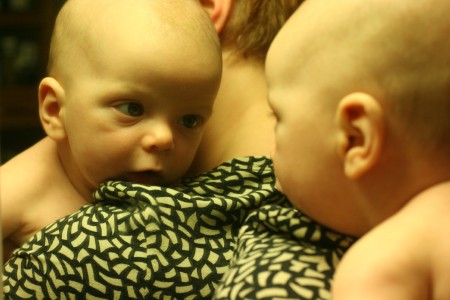 Through the looking glass, okay?
A few months back, to the great amusement of late night talkshows (US) and topical comedy quiz participiants (UK), a group of scientists lodged a complaint against a trend in current cinematic science fiction: It’s not realistic enough. The sciency part of it is not good enough. Science fiction stories should help themselves to only one major transgression against the laws of physics, argued Sidney Perkowitz. To exceed this limit is just lazy story-telling – time travel being a bit like the current french monarch in most Molieré plays. The best works of science fiction follows that almost experimental formulai: change only one parameter and see how the story unravels.
The criticism that started already in the first season of ”Lost” and has become louder ever since was precisely this: the writers clearly have no idea what they’re on about, they haven’t even decided which rules of physics they have altered. The viewer is constantly denied the pleasure of running ahead with the consequences of the changed premise and then watch how the story runs its logical course. Off course, a writer may add surprises, there is pleasure in that to, but you cannot constantly change the rules without adding a rationale for that change. That’s just cheating (or its playing a different game altogether. That is acceptable, of course, I’m not saying it isn’t, I just think this accounts for a lot of the frustration people experience with shows like ”Lost” or ”Heroes”).
The comedians who ridicule the scientist claim that the latter miss the point: Science fiction is suppose to be fiction. But in fact the point is that even fiction, at least good fiction, is not arbitrary.
It struck me that the point made by this group of scientists is very much the reaction that kids have when you break the rules in their pretend play. (There’s an excellent account of this in the opening chapters of Alison Gopniks book ”The philosophical baby”).
One of the interesting things about kids is their ability to, and interest in, pretend play. They are from a very early age able to follow, or to make up, counterfactual stories and imaginary friends and foes, and the stories that play out have a sort of logic. If you spill pretend tea, you leave a mess that needs to be pretend-mopped up. Many psychologists now argue that this is more or less the point of pretend play: you work out what would happen if something, that does in fact not happen, were to happen. The more outlandish the countered fact, the more work you need to put in to draw the right, or sensible, conclusions, and the more adept you become at reasoning, planning and coming up with great ideas. Stories that doesn’t further that project might be nice nevertheless: literature has other functions, after all. But the decline in this particular quality in current science fiction is still a sound basis for criticism. Even a baby can see that.
A unique set of influences
14 april 2010 | In Books parenting Psychology Self-indulgence | Comments?In one of the early notebooks in which I used to put the kind of thought, rants and musing that nowadays makes it into this blogish existence I made some sort of remark about how to overcome the anxiety of influence; the suspicion that all ones work is somehow derivative. ”One can at least aspire” I wrote (or something like that, I obviously didn’t bother to actually find the thing. It’s a notebook, for crying out loud. It doesn’t even have a ”search” function) ”One can at least aspire to be the result of a unique set of influences”. In other words: it doesn’t much matter whether one is little less then the effect of what one has read, seen, heard etc. since the longevity of life in the plastic state makes sure that some originality will ensue even from that process. In addition: to track down the complete set of sources that ”made” a particular author/thinker is excellent fun. One can even toy with that sort of thing in ones writings, provide hints and such (misleading ones, if one wants to be clever).
Anyway, I’m going somewhere with this. Oh, yes: I find that most things I write in hindsight quite clearly is the result of what I was interested in at the time, even when those things were not obviously related to begin with. Thus, for instance, it is highly unlikely that my dissertation would have gone down the way it did, were it not for the fact that I happened to be into cognitive science just before I got the job (much to the dismay of my supervisors). The sort of value theory I was into before that was much more of a dry, conceptual analysis kind of thing.
So I’m pretty sure that something interesting will come from my current preoccupation with the two subjects of Psychopathy and child (infant, actually) psychology. It’s not hard to find a link, obviously: developmental processes are key in both areas, but I’m very likely to make a big point out of this, merely for the reason that these are the things that interests me now.
For instance: one current trend in chid psychology is to stress the wide, undiscriminating attention of infant and toddler (more of a lamp, than a spotlight) which make them better than adults at noticing task-irrelevant features. Psychopaths, according to another book I’m reading, are quite the opposite: one of the cognitive peculiarities of psychopath is their ability to focus, and their inability to remember task-irrelevant features. As pointed out in the previous post, attention may suffer when the amount of information increases, but the reverse is true as well. The inability to shift attention when previously irrelevant information becomes relevant, or shows you that a shift is needed, is clearly a problem in a variable environment, such as our, social one. Infants are in the process of finding out what is relevant, and thus need not to focus attention just yet.
My third current interest is in the cognitive science of literature. I’m likely to find a way to make that relevant to the project as well.
(Currently reading)
The Nightly Book Club reads Delillo
15 mars 2010 | In Books parenting | Comments?This book (point omega, by Don Delillo) will stand out in my memory for one reason in particular: it’s the first book we finished together. Over the last few nights, I’ve been trying to lull Benjamin (Young Sir) to sleep in his own bed, by reading it out loud to him. It hasn’t worked as intended, but for each day he becomes more contented just lying there, listening, smiling and waving when I raise my eyes from the page. Patently not bored. (We did a few nights of ”The House of Wits” to, but 693 pages read out loud means a long wait for closure, not suitable for infants).
Point Omega is very recognizably Delillo, with the questions without question marks and the penchant for situations when time slows down and something therefore becomes, you know, art, somehow. You pick a situation, at random or with great care, and you attend to it, as you might so easily not have done. Even when the events that unfurl are very dramatic indeed (the Kennedy-assassination, post 9/11 New York, disappearances and violence), what happens is almost never what matters. And he has a way with sentences.

changing preferences
2 januari 2010 | In parenting Self-indulgence | 4 CommentsA number of things are said to happen when you become a parent. One of these is the curious event of changing preferences: an unprecedented, radical and rather immediate switch in interests and priorities which, so it is said, is impossible to imagine beforehand. The last bit is usually added by people who are already parents, and with more than a detectable hint of smugness. This smugness is earned by not sleeping very well.
(Topic for an another blogpost: the inflated case for first-hand experience. When people say things like ”you had to be there” I often react ”Well, then you must not be telling it very well”. Not to their face, obviously. Also: don’t say ”this town is too small for me”, it has the metaphorical implication that you are in some important sense bigger than the people for which the town in question is not too small. Rather, say ”I’m not capable of flourishing in this environment”. Or, come to think of it: don’t say that either. You might get a short, sharp visit from the smack-fairy).
What’s interesting about changing preferences is that they muck rational decisions up a bit. If a travesty of the classical model of a rational person is correct, and a rational person is one who acts in accordance with his/her preferences: How can we make the decision that involves changing those preferences rationally? What preference is satisfied by my creating new preferences? It might be a meta-preference: for having preferences that are more easily satisfied, for instance. If you have a preference for chinese food, and there is no good place for chinese food where you live, and you wont move (what? I question your devotion to chinese food, sir) there is a case for you giving up on this preference. At least if you take the preference to be contingent on its own existence, i.e. if there are no preference independent reasons to care for chinese food.
If the change in preferences brought about by having a kid is radical and unforeseeable, it becomes even more difficult to make the decision rationally: you don’t know whether the preferences created will be easy to satisfy, nor what they will involve when it comes to changing your preferences for things that you know genuinely care about. In fact, you might even loose the preference (meta- or not) that made it seem like a rational decision in the first place.
Comparable decisions are to start caring about a sports-team or to use drugs. In particular the latter is comparable, since it has a tendency to consume other preferences. (The drug case is different insofar that it is very rarely a good idea).
What adds complexity to the child-case is that not only do you change your own preferences: you create a new subject of preferences and those are in a very real sense unpredictable in the long run.
Let the record show that so far, there has been a clear net gain in preference satisfaction, notably among the unforeseen ones (such as rekindling my interest for preference changes), and a non-significant loss of previous, important ones.