On caricatures, freedom and the nature of assholes
13 januari 2015 | In Comedy Emotion theory Ethics Hate Crime media Moral philosophy Philosophy of Law politics Psychology Psychopathy Self-indulgence Uncategorized | Comments?I have to admit, I’m not overly fond of caricatures. Never have been. I guess sometimes they manage, just like a good metaphor does, to capture something important about its object that was not as obvious before. The thing that a caricature brings out about the object is usually intended to render it ridiculous. Most things are partly ridiculous, of course, it’s almost never a useless way of viewing a thing. But it becomes particularly useful if the thing, or person, or group, is in power, is pompous, is revered to an unreasonable extent. It becomes less so, even harmful, if the thing or person, or group, is already despised, disenfranchised, already treated as ridiculous.
The reason why I’m not overly fond of caricatures, or metaphors for that matter, is that they rely on putting emphasis on certain things at the expense of other things, and the result, the ”translation”, as it were, depends on whether that serves to correct the received view in order to reflect the actual importance of those things. Caricatures have a history of ridiculing power, and that history is well-rehearsed these days. But they also have a history of serving power. Of dehumanizing people it deems of less importance, which makes those people even easier to disregard, or even to kill.
There is an argument that says that we have freedom of speech in order to protect precisely the sort of statements that we do not like. This is spurious. It may be true that the extent of freedom of speech can be measured by exactly how offensive, vitriolic, hateful, debasing, threatening expressions that it allows, but it hardly seems to be the point of having freedom of speech. Some people will say that freedom is a value in itself. Others, like the more often quoted than read J.S. Mill, say that freedom of speech is an instrumental value, which serves a function. And it can be limited when it fails to serve that value. On this account, we can say that freedom of speech is a matter of costs and benefits. The offensive can occasionally be a benefit, the hateful very rarely is, but we may want to preserve the right to make hateful assertions because the total value of relatively unregulated speech is positive. The benefits may outweigh the costs. (It should be noted that this analysis could, and, I believe, should, adjust for fairness. If the costs and benefits are unfairly distributed so that the worst off bears the greatest burden, the cost may be unacceptable even if it is outweighed in absolute terms). Hate speech laws tend to draw a line between the offensive (which is allowed) and the hateful (which is not), but some legal scholars and a lot of libertarians believe this distinction fail to track anything of moral importance.
Now. In moral philosophy, the notion of an asshole is quickly turning into a technical notion of considerable use. An asshole is a person that does not infringe on other peoples rights, but does everything he/she can to reap the benefits for him/herself, and nothing to help others. It is the kind of person that uses freedom of speech to say all the worst things he/she is allowed to, while contributing nothing to a worthwhile discussion. The behavior of such people tend to be on the cost side in the cost/benefit analysis of a right. Assholes are on the cost side, and when they become too many, the instrumental value of certain freedoms decreases. At the same time, the fact that we tolerate them (even encourage them in certain contexts) may be a testament to the strength of our society, our resilience. Assholes also serve the considerable function of demonstrating the gaps in our systems and institutions.
I’m going somewhere with this. I have not made myself familiar with the works of Charlie Hebdo. I don’t know french, and I’m not sufficiently familiar with the cultural and political context. If I understand things correctly, their tendency has been to make fun (if that is the right word) of power and pompousness in all it’s guises. It certainly is no straightforward instrument of power. But equal treatment does not amount to equal effects, especially when the people and groups treated have different social standings to begin with. Some of their work may render things ridiculous that we all benefit by viewing in that light. Some of it may serve to dehumanize and ridicule people that are already being discriminated against, whose social standing in the context is low. The latter is an unmitigated cost, and it is the work of assholes, in the technical sense described above. Caricaturists will often tend towards asshole-hood. And it is possible that they should, that it is for the good that there are people, and publications, like that. But it would probably be unbearable if we were all like that. And while the extent of free speech may be measured by the worst things it allows, the value of it must be measured by the best things it allows that would otherwise have been banned.
Simon the Sorcerer
4 november 2010 | In BBC Comedy | Comments?
It can hardly be called news (then again, this is hardly a news-oriented blog) but a small notice on the often readable Chortle webpage quotes Noel Fielding as saying that Simon Amstell (”Who?” I hear you say, since showbiz memory has the duration of a sensory memory trace) ’ruined’ Never Mind the Buzzcocks. Apparently, celebrities became hesitant to go on the show out of fear for Simon’s derisive remarks. This may very well be true, but that was clearly also (but only) part of what made Amstell one of the most brilliant hosts of any comedy panel show ever. More importantly, while some celebrities did presumably chicken out for this reason (only to return when one of the kindlier guest hosts arrived. Terry Wogan, for instance. I mean WHAT!?), others performed beautifully under the stress. As the prime example Josh Groban credibility score absolutely hit the roof after his excellent performance in 2008.
For my students
14 oktober 2010 | In Comedy Ethics Psychology | Comments?On monday, the course I teach goes into second gear: Normative Ethics. First out is the doctrine of ethical egoism. Ethical egoism, the idea that you should do what lies in your own self-interest, is distinct from psychological egoism, the idea that in fact you are only motivated by your own self interest. In its strong version, this latter view has it that you cannot be motivated by anything else. Genuine altruism is impossible. Psychological and ethical egoism are two very different things, it is said. One is about what is the case, the other is about what ought to be the case.
Now, consider that ought implies can. I.e. it cannot be the case that you ought to do something that it is impossible for you to do.
So, if you cannot be motivated by anything else than your own self-interest, it cannot be the case that you ought to be motivated by something other than your own self-interest.
So it would seem that from ought implies can and strong psychological egoism it follows that you ought to be motivated by your own self-interest.
But note that this is not what ethical egoism claims: Ethical egoism says that you ought to promote your own self-interest, not that you ought to be motivated by your own self-interest. And even if we cannot be motivated to promote the greater good, our actions can certainly promote the greater good. Psychological egoism does not even seem to bar the possibility that we intend to bring about other results, only that we cannot be motivated to do so.
So, since we can promote the greater good, it is logically possible that we ought to. But, if psychological egoism is true, it is only logically possible that we ought to promote the greater good by accident.
See you monday!
The baby critic
15 april 2010 | In Books Comedy media parenting Psychology Self-indulgence TV | 3 Comments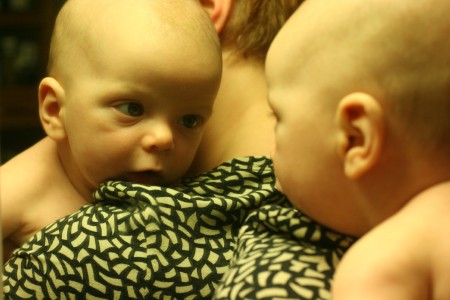 Through the looking glass, okay?
A few months back, to the great amusement of late night talkshows (US) and topical comedy quiz participiants (UK), a group of scientists lodged a complaint against a trend in current cinematic science fiction: It’s not realistic enough. The sciency part of it is not good enough. Science fiction stories should help themselves to only one major transgression against the laws of physics, argued Sidney Perkowitz. To exceed this limit is just lazy story-telling – time travel being a bit like the current french monarch in most Molieré plays. The best works of science fiction follows that almost experimental formulai: change only one parameter and see how the story unravels.
The criticism that started already in the first season of ”Lost” and has become louder ever since was precisely this: the writers clearly have no idea what they’re on about, they haven’t even decided which rules of physics they have altered. The viewer is constantly denied the pleasure of running ahead with the consequences of the changed premise and then watch how the story runs its logical course. Off course, a writer may add surprises, there is pleasure in that to, but you cannot constantly change the rules without adding a rationale for that change. That’s just cheating (or its playing a different game altogether. That is acceptable, of course, I’m not saying it isn’t, I just think this accounts for a lot of the frustration people experience with shows like ”Lost” or ”Heroes”).
The comedians who ridicule the scientist claim that the latter miss the point: Science fiction is suppose to be fiction. But in fact the point is that even fiction, at least good fiction, is not arbitrary.
It struck me that the point made by this group of scientists is very much the reaction that kids have when you break the rules in their pretend play. (There’s an excellent account of this in the opening chapters of Alison Gopniks book ”The philosophical baby”).
One of the interesting things about kids is their ability to, and interest in, pretend play. They are from a very early age able to follow, or to make up, counterfactual stories and imaginary friends and foes, and the stories that play out have a sort of logic. If you spill pretend tea, you leave a mess that needs to be pretend-mopped up. Many psychologists now argue that this is more or less the point of pretend play: you work out what would happen if something, that does in fact not happen, were to happen. The more outlandish the countered fact, the more work you need to put in to draw the right, or sensible, conclusions, and the more adept you become at reasoning, planning and coming up with great ideas. Stories that doesn’t further that project might be nice nevertheless: literature has other functions, after all. But the decline in this particular quality in current science fiction is still a sound basis for criticism. Even a baby can see that.
The Next Doctor
1 februari 2010 | In BBC Comedy | Comments?In an episode of BBC’s ”Chain reaction”, where noteworthy people, mainly comedians, get to interview each other (A interviews B, in next program B interviews C, and so on. It’s a chain reaction.) John Lloyd – legendary producer of things funny – suggested to his interviewee Phil Jupitus – comedy-quiz fixture and master of comedy in the short format – that he, being so promising, should take the ”next step” in his career and do something great and influential and worthwhile. Phil, quite sensibly, answered something like ”I’m pretty happy with my work, thank you very much. Let the young people think of new and exciting things to do”.
But one sees what John Lloyd was up to, does one not? Trying to manage Phil Jupitus career, think of things for him to do. One sees brilliance, thinks that there is more where that came from, and one wants to exploit it further.
At present, I’m a bit like that with Sue Perkins. I want her to be in everything, I want her to have bit parts in Shakespeare dramas, I want her on every comedy quiz show devised by man, I want her to go exploring and post amusing reportages from whatever she’s up to. And then it hit me, just now: I want her to be the next Doctor.
David Tennant has set a standard for the next generation of doctors, and I have not much faith in the current place-filler, so if Doctor Who is to move on, I see only one suitable candidate: Ms Perkins.
the year of David Mitchell
3 januari 2010 | In BBC Comedy | Comments?David Mitchell is no Eddie Izzard, whose free-floating musings on the history of the world can have you in fits and influence the structure of your thinking for weeks after listening to it. Nor is he a Bill Bailey, whose considerable musical talents were featured in this years ”BB’s guide to the Symphony Orchestra” (The recycling of material from earlier shows, especially the brilliant ”Is it Bill Bailey”, shouldn’t bother anyone. How can you get enough of the Belgian Jazz-version of the Doctor Who theme?). David Mitchell is not a comedian for the big arena. He could not entertain you with an impromptu lecture, or lull you to sleep reading anything loud, like a certain S. Fry (whose tweets will be missed, but the prospect of a second installment of his autobiography has me almost indecently excited). And he does not have the good-natured instant rapport with the audience of a Dara O’Briain (as Mitchell’s refusal to dance even a little on ”the big fat quiz of the year” the other night amply demonstrated).
But David Mitchell was the consistently funniest man during 2009. He is simply molded to fit the all-important comedy quiz show format, and 2009 saw him perfecting his sound-bytes and his trade-mark rants. Perhaps too heavily featured in the podcast ”David Mitchell’s Soapbox” but put to great effect in small doses in episodes of ”Qi”, ”Would I lie to you”, ”I’m Sorry I Haven’t a Clue”, ”Have I got News for you” and ”Mock the week”. He also squeezed in series of both ”That Mitchell and Webb Look” and ”That Mitchell and Webb Sound”, showing that radio actually is the better format for the duo, hosted another series of ”The Unbelievable Truth” on BBC radio 4 and provided consistently interesting, funny and yet utterly common sensical columns in the Guardian. Oh, and there was a new series of ”Peep Show” too, but personally, I find it too painful to watch.
He is certainly not the first british comedian to make a virtue out of being a bit displeased with state of affairs, and being amusingly sarky and witty about it, but in 2009, no one did it more effectively. And his capability to respond to insults should be an inspiration for generations to come.
So, it’s correct but not funny, that’s what you’re saying?
11 oktober 2009 | In Comedy Meta-ethics Neuroscience Self-indulgence | Comments?The day before yesterday, I made my first proper venture into the unchartred waters of neuroscience. For reasons too interesting for words, my debut took place at a department for clinical neurophysiology in Gothenburg. I delivered a talk called ”Value-theory meets affective neuroscience – and then what happens?”. (”Not much” is disappointingly often the answer). This talk, a version of which I gave to a mostly empty room at the Towards a Science of Consciousness conference in Copenhagen back in 2005, argues that these disciplines should colloborate of key motivational concepts. The amount of ignorance in each discipline of the work done in the other is nothing short of embarrasing, and in dire need of rectification (enter: not so petit moi).
The talk is also notable (yes, I think like that about my own writings) because it contains my ”no-Cinderella” argument about reference: If you have a concept but no natural event or property that perfectly fits the concept, you go for the event/property/step-sister on which/whom you have to cut of the least amount of toes. It’s basically the ”imperfect derserver” theory, but more cute, by far.
Anyway: in the talk, I’m intrducing some key arguments in ethical theory and meta-ethics. The fact-value distinction is backed up by an outline of Hume’s Law: You cannot derive an ’ought’ from an ’is’. There are cases when we seem to do precisely this, however. Like when I say that your pants seem to be on fire, and you conclude that your really should put it out. But, Hume’s law dictates, there is always a hidden ’ought’-clause hidden in these cases. That you ought not to wear burning pants after labour-day, for instance.
Hold for laughs 2-3-4. It is not happening, is it? No.
It might not be as funny as I think, but there might be another problem to, to which I cling desperately: I’m talking philosophy to a bunch of non-philosophers, and for a non-philosopher, it is not that easy to distinguish the jokes from the real thing.