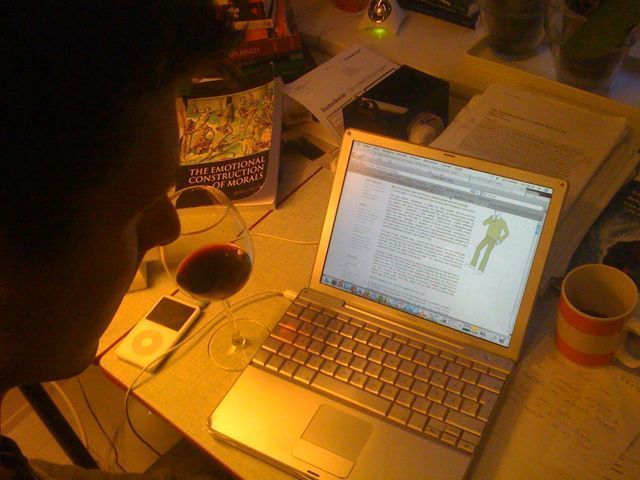
On Thursday, I’m supposed to summarize and criticize a draft for a paper called ”the Methods of Ethics” (yet contains no reference to Sidgwick) with the subtle subtitle ”conflicts built to last”.
The paper (intersting and very nicely written) reflects on the philosophical importance of the ”dual process” model for moral judgments and points out that having two processes influencing our moral judgments is useful since each process can correct the mistake that the other leads to on its own. In vague and possibly misleading terms, the ”emotional” process is in place to make sure that the ”cognitive” process does not run away with us (getting us stuck in prisoners dilemmas and repugnant conclusions. Also, one presumes, to keep us from making biased calculations), the cognitive process is there to make sure we don’t get stuck in emotionally reinforced prejudices.
One important role for the emotional process is to tilt the actual and perceived utilities of an option so that, for instance, a seemingly rational breach of promise becomes less tempting, due to expected guilt. (It’s a choice-archictural device, to speak with the nudge people.) The two processes are commonly held to be representative of two different moral theories. The cognitive process is broadly ”utilitarian”, and the emotional is broadly ”deontological”, spurring some philosophers to say that the dual process model is a perfect diagnosis of the history of moral philosophy. The relation between the two processes, then, is essentially a conflictual one.
It’s an interesting speculation, but there are complications.
First: there might be several decision procedures at play; the ”dualism” is merely a handy simplification with a long history, reaching us from Plato via Hume, and Jane Austen, for crying out loud.
Second: there is no reason to think that the cognitive process as such is utilitarian – there are other reasoned ways to reach a moral decision.(The empirical work on these issues is just getting started). Nor is there any reason to believe that our emotions are essentially deontological, especially seeing how our emotional systems are among the most complicated, interconnected and plastic in the brain. One can easily imagine an agent whose emotions are always targeting the utilitarian option, who is an intellectually convinced deontologist, for instance.
Third: even if our deliberation can occasionally go against our emotional reactions, what that deliberation is about, what consequences to take into account, has to be established somehow, and emotions certainly play a central role in that process.
I believe it is a mistake to see these processes as being essentially in conflict, rather than in cooperation. We are probably best of when we get the same verdict from both processes (which, admittedly, might require some negotiation) and we usually get into trouble when they don’t.
The paper proposes that the take home lesson from these findings is that we should not be that concerned with reaching the moral truth, but with reasoning correctly, i.e. using both processes. But if we have no moral truth to strive towards, or to use as a corrective tool, how do we know when we have reasoned correctly? Especially seeing how the outcome of each process depends on a number of contingent circumstances. There are infinite possibilities when it comes to what sort of a balance is struck between the two processes, so are they all equally valid?
It’s noteworthy that when considering the Prisoners Dilemma case, the way the author determine that emotional processess help us reach the right decision is by showing that it leads to the best overall consequences. It is good that we have two processes, but that goodness must somehow be assessed, and that calls for one criterion of rightness, not several.