Charleston – on hate crimes, terrorism and oppression
25 juni 2015 | In Crime Ethics Moral Psychology Philosophy of Law politics Psychology | Comments?First, there are two initial question regarding how to categorize this event: Was it a hate crime? And was it an act of terrorism? The answer seems to be straightforwardly ”yes” to both. Statements reportedly made by the suspect, the symbols he wore, the choice of victims and place, the reported premeditation, etc. all speaks to this being a racially motivated crime, i.e. a hate crime as well as a crime committed with the intent to bring about societal change or, rather, to stop societal change, or to bring things back to the way they were, i.e. an act of terrorism. I will put most emphasis on the hate crime angle, as it is my area of expertise.
Hate crime. The Charleston case is one. On nearly every conception of what an hate crime is, if current information stands, this qualifies as one. Some commentators has said that we need to await the result of the full investigation, and that is always a good idea, but it would be surprising if that investigation would undermine what seems to be a blatantly clear cut case. There are a number of hate crime conceptions, that only partly overlap. The most common idea is of hate crimes as distinct by motivation, i.e. the reason why the perpetrator committed the crime. But in fact, many jurisdictions interpret hate crime as a case of intentionally selecting victims from a protected class, and puts less weight on the reason why the crime was committed. This is an advantage in two ways; it does not require proof of motive, and it does not rely on the controversial notion of punishing motive. A third conception understands hate crimes as defined by intent; the intent to strike fear in the targeted community, for instance. On this account, hate crimes are more or less a species of domestic terrorism. A fourth identifies hate crimes as crimes expressing a certain message to the targeted crime. (The expressive account has however been deemed unconstitutional in the US due to its conflict with the 1st amendment). The Charleston case seems to qualify as a hate crime on all these accounts. It seems to be hate motivated, the victims and place were choices because of their racial significance, the intent was (apparently) to send a message and to instigate race war.
That being said, South Carolina does not have a hate crime law. This in itself is worthy of note. The development of hate crime laws in the US was preceded by the civil rights movement, and is generally held to have the differential treatments of former slaves as second-class citizens as its background. The fact that South Carolina has not taken this measure, in conjunction with factors like flying the confederate flag and naming streets after confederate generals, means there is a long way to go. That SC does not have a hate crime law is not the end of the matter. The case can, and it looks like it will, be run as a federal case. Since the Matthew Sheppard and James Byrd Jr Hate Crime prevention act was signed into law in 2009, federal authorities have extended abilities to handle cases the states are unable or unwilling to take.
This is important for two reasons. First, the federal government having to step in in order to make justice possible in a race based case in a Southern state says something about how America is divided. Second, in order for this to be run as a hate crime case, it must be run on a federal level. But hate crime laws are penalty enhancements laws. And given the gravity of the case, it is quite possible that the penalty, if it had stayed in South Carolina state court, would have been the death penalty. In fact, the probability that it leads to the death penalty in a federal court may be lower. Which means that in order for it to be judged as a hate crime, it may lead to a lower penalty being given. On this account at least, this case can become legally interesting.
Why are hate crimes worse than other crimes? This was a massacre, a mass murder, an act of terrorism. What is the significance of naming it a hate crime? As I said, hate crimes laws normally take the form of penalty enhancement statutes. This is because they are deemed worse than ”parallel” crimes, i.e. similar crimes absent the hate element. There are a number of reasons why, some having to do with the discriminatory nature of these acts, others with the maliciousness with which they are being committed. The most common account is harm-based, however. Hate crimes, according to influential scholars like Paul Iganski and Frederick Lawrence, hurt more. The primary victims typically experience more psychological harm when the crime is hate motivated. In a case like this, when the outcome is death, that is not relevant. But the additional harm also exist on the victims group and on society in general – it may, for instance, worsen the relations between groups. Both these accounts are relevant here; the targeted group is reminded of the risk it is at, and the tension between groups hightened.. Indeed, that was the expressed intent of the offender – to start a race war
Before moving on, lets just say this on penalty enhancements: Say he is sentenced to the death penalty, and that penalty enhancements cannot come into effect. Still, it is not pointless to treat it as a hate crime. Indeed, many victims and victimized group say that the penalty enhancement is less important than is naming the motive in these cases. Recognizing and condemning these types of crimes is the more important part. Hate crime laws has an expressive function.
So, was this an act of terrorism? Again, the answer seems to be straightforwardly ”yes” by most definitions. But perhaps not all. What makes an act of terrorism is the intent (together with means reasonably fit to purpose) to cause fear and force societal and/or political change. According to one statement, Roof wanted to bring about a race war, which is certainly one way of doing that.
What complicates matters is that Roof, much like the Norwegian terrorist Breivik, seems to be a conservative terrorist, i.e. one that wants to stop change. Or to change things back the way they were. And this may be one of the reasons why he was not immediately and universally being called a terrorist. The ”typical” terrorist is someone somehow alien to the system which he/she wants to change. The thing that people keep pointing out is that this act was the extreme expression of white supremacy, and that this ideology is actually not that alien to the dominant culture. Many commentators that wants this branded as an act of terror, also thinks that the racism expressed is not uncommon, indeed that these attitudes are entrenched in society, part of the norm. There is some tension between these two aspects: Do we want to portray him as somehow normal, which means that the problem is much, much bigger than the risk of these kinds of attacks? Or do we want to describe him as something ”other”, something alien to our system? The reluctance to accept something entrenched in ”our” culture to be capable of terrorizing that same culture is probably one of the reasons we turn to questions about mental health in these cases. Why would a person congruent with the dominant culture in what is being described as a racist society otherwise go to these lengths, take this sort of risk? In the absence of a deep cultural divide between him and us, we need mental health issues to distance ourselves from a man capable of such heinous crimes.
The reasons why it might not be understood as terrorism is that we do not yet know whether there is any clear organization behind him – which is typical of what people think of as terrorism. Of course, the need for such organizations to facilitate acts of terrorism is considerably weakened by the internet, which make it possible to cherry-pick an ideology, a support base, and a methodology to suit you. Secondly, that the criminal is (as Åsne Seierstadt stated in her book about Breivik) ”one of us”, i.e. not that different from normal members of the population. This is significant as it means there is no discernible ”other” to direct retaliation towards. Terrorist threat is ”supposed” to come from outside, from people with no other route to a position of power. Rather than describing it as an act of terrorism, then, it could be branded as an act of oppression.
The significance – Charleston as a symptom
What does this act mean? What does it signify? Is it a sign of things getting worse, and this is just a symptom of growing racism and racist rhetoric? Or (counter-intuitively) may it be a sign of things getting better? Racist offenders may find their justification in others expressing the same views. But they also find their justification in thinking of themselves and the society and values they care about as being somehow threatened. While hate crime criminals are often part of the majority, it is when that majority think of themselves as loosing their privilege that the need to commit a crime to keep that privilege arise. Lynchings were often a reaction to former slaves behaving in a way that former slaveowners and other whites thought of as unacceptable for a black person. Similarly, hate crimes are often understood as a response to people of the hated group stepping out of their place, and there being no other way of putting them back. Segregation, privilege and power means rarely having to worry. But, of course, privilege should be threatened. People like with the beliefs that Roof seem to have should be feeling threatened, because the order they want should be collapsing. If this is how it works (note that this is just a hypothesis), a rise in these types of crimes is likely to occur as things becomes better at a more everyday, ”structural” level.
Inexcusable racism
24 juli 2014 | In Emotion theory Ethics Hate Crime media Moral Psychology politics Psychology | Comments?Everyone’s a little bit racist. Basic cognitive functioning relies on generalizations, after all. Unwarranted initially, in order to get off the ground, and then more or less supported, or rejected, or revised by experience, by evidence. Slightly less basic cognitive functioning requires that we adjust our generalizations in the face of evidence. We adjust our explanatory categories, we fine-tune and narrow in on something that starts to look like likelihood. Or, rather, we do this when there’s sufficient reasons to do so. And those reasons are not just epistemological, they are to a large extent pragmatic. Most of us are lazy thinkers, and all of us have limited time to spend on adjusting categories. We only do when it’s useful for us to do so, or when we have the time and interest to do so at our leisure.
We assign significance to superficial differences like skin color, mode of dress, language, gait, because superficial differences are what signifies internal and explanatory differences when no other information is readily available. (To be fair: superficial difference often DOES correlate with less unimportant things.)
Prejudices are explanatory shortcuts, and quite often they serve us well. Sometimes by being dead-on, otherwise by knitting us closer together with others with similar needs, who jumped to the same unfounded conclusions about the explanatory order of things. The prosocial function of shared false beliefs should not be underestimated. Organized religion springs to mind.
People are, by most accounts, naturally geared towards bigotry, at least under the circumstance of groups competing for resources that seems to have prevailed through a significant part of our formative evolutionary past. The thing to explain is not that we are bigoted, but that we occasionally stop. (Even so, what categories matter, and how to assign value, is, of course, learnt. The tendency is present in the cognitive default state, but needs triggers and particulars to get underway and be filled by content. A person born into a truly egalitarian world would arguably have the tendency to assign significance to the superficial, but lack most of the triggers to do so, and the guidance to do so in any particular manner. Bigots, if they were still to develop, would be of a much more idiosyncratic ilk).
We may be partially excused for being racist, then, as it is in our nature to make a big deal out of differences, and we can often find at least some evidence to back a prejudice up. We are likely to do this, as our prejudices are often at least partly emotional in nature, and we are likely to go looking for confirmation, rather than rejection, of the rationality of those emotions. Emotions too have an evolutionary function, as indications we do well to trust when information as the the value of things is scarce. Awkwardness in the face of the unfamiliar calls for post hoc rationalization (ironically, the pressure towards a racist explanation of that awkwardness increases when there is a reluctance to self-attribute prejudice).
Yet we do blame people for being racists and are presumably right to do so. Why? Because we have every opportunity to revise our first impressions. The evidence as to the irrelevance of these superficial differences is so overwhelming, and the case for the basic equal value of persons is so much stronger than any alternative account, that there is really no excuse if you’re an adult, intelligent person living under non-warlike conditions (people at war, or under extraordinary stress, may sometimes be excused).
The point is that people should be blamed, not merely for harboring racist (and other, avoidable) prejudices, but for failing to revise them in the face of evidence, and for the failure to look carefully enough for evidence that falsifies that prejudice. In many cases, the reason for such failures is nothing more sinister than basic cognitive laziness and self-interest.
There exist, of course, a skeptic safe haven for the bigoted, and it consists of distrust in the sources of evidence. If you believe that, say, the liberal elite has an agenda to mislead concerning the nature and character of the groups you disfavour, you may well protect your prejudices against such challenges. The strategy is fundamentally flawed, as it depends on not adopting skepticism in equal measures to other sources of information, like the sources you use to entrench and confirm your pre-existent prejudice. But the model provides some light when it comes to explaining why some people remain bigoted. It also shows the depth of the problems caused by societal distrust.
A note on antipathy and phobias
6 september 2013 | In Crime Hate Crime Moral Psychology Psychology | Comments?Bah! Semantics!
It would seem that semantics is the least interesting aspects of things like islamophobia and antisemitism. This may well be the case, but if you’ve ever happened to investigate into anything, you know that the least interesting aspects of things are often quite crucial. While linguistic-turn era early 20th century Oxbridge-type philosophy is often caricatured as claiming that semantics is everything that matters, the more accurate claim made is that semantics matters too.
It is, at the very least, noteworthy that while antisemitism and islamophobia are treated as examples of the very same attitude (a negative one) with a variation in object (Jewish people/Muslims), they take different lingusitics forms even on the attitude side. Why use ”anti-” in the one case, and ”phobia” in the other? Are they interchangeable? It’s clear that they are often used as interchangeable, but this may hide an important aspect: There’s a distinction at work which connects to different modes of negative attitudes and behavioral responses. These modes afford different types of explanatory schema.
Aggression and Aversion
The word ”anti-” connects to aggression, the word ”phobia” to aversion. These are both negative reactions, but aggression is connected to the behavioral response of approaching the object, while phobia is connected to the behavioral response of withdrawal. If I have a fear of spiders, I don’t primarly seek them out, even to kill them, unless there’s another way to avoid them. I’m sure there are people who are anti-spider, and will seek spiders out to kill them, but the groups of spider haters and spider fearers are probably just barely overlapping. The relation between fear and hate is not straightforward. Because of this, fear-based explanations of acts of aggression are incomplete at best. You always need a further explanatory step to show why this instance in particular provoked an aggresive response, rather than an act of avoidance.
If the semantics of ”phobia” and ”anti-” reflects this distinction, it suggests that the common perception is that Jewish people are attacked as a consequence of anti-semitism, whereas muslims are avoided as a consequence of islamophobia. Of course, both groups suffer from both types of responses.
Two problems
The distinction between aggression and avoidance is further of interest as they neatly divide the problems of racism up in two piles, it’s relatively easy to target aggression with the use of criminal law, but not so easy with avoidance (Discrimination laws targets a very limited set of the latter). Yet avoidance is probably the greater problem, as it is likely to account for most inequalities and as much of the perpetuation of antipathies between groups as the aggression does.
On overt and covert racism
28 april 2013 | In Emotion theory Hate Crime Moral Psychology politics Psychology | 1 CommentThe face of racism is often characterized by a swastika crudely painted on a wall, or a group of young white men screaming out their hate and anger towards a member of a hated group. The consequences of racism is often portrayed as a beaten up, dead body. This, most of us think, must stop. Presumably, open, convinced, ideologically driven racists thinks so to. Presumably, as with any kind of war, they regret that it had to come to this.
These expressions of hate and prejudice are highly problematic, and the long term effects, especially if they are not swiftly and forcefully dealt with, should not be underestimated. But what would happen if they disappeared? Would the problem av everyday racism – expressed in mild aversions, the unlikelihood of succesful encounters, covert discrimination – diminish as well, or would it, in fact, become worse? The question is this: what is the relationship between overt and covert instances of racism?
If we want to point out why racism is a bad idea, we are well served to point to these worst cases – the lynching of James Bird, the murder of Matthew Sheppard, and we do that rather than point to a job applicant narrowly losing out to another due to the foreign sounding nature of his or her name.
Yet the latter kind of situations are in all likelihood much more common and their effects much more widespread in modern racism. Most people overtly believe in the value of equality, but still suffer from unconscious prejudices. We can deal with the easy cases, but when it becomes complicated, and we can make up a reason that justify our aversion, prejudices have a chance to win out.
Explanations are afforded by generalizations, but motivations and emotions often draw their power from individual cases.
We are on the watch for populisitic right wing parties, because we still got the more obvious racists to keep before our eyes. We remember. We often recognise and react towards our own racist tendencies by the self loathing that comes with sharing beliefs with violent and obviously misinformed perpetrators. But what if they disappeared? Would we lack these markers of racism and thus loose our bearings?
Or, alternatively: do these instances now serve the function of carrying the weight of all racism, and the problems with it? So that if they DID disappear, we would have to face the fact that it’s actually as much the implicit racism of convinced egalitarians and liberals, that cause the unfair outcomes? Or would such a scenario rather be used in support of the racist idea that any inequality remaining in the absence of overt racism must be due to inherent inequality between the ”races”?
Deterrence and rehabilitation
7 maj 2012 | In Crime Ethics Moral philosophy Moral Psychology politics Psychology | Comments?
A suitable mode of thinking when it comes to legal punishment is in terms of functions. What functions are punishments supposed to perform? Let’s restrict this discussion to prison sentences for now, but assume that it applies to other forms of punishment as well. In the literature, four functions are easily distinguishable. The question I’d like to raise is whether these functions can all be performed by the same sort of punishment, or if they come into conflict.
1. The first function is deterrence. A spell in prison is an unpleasant thing. At the very least, presumably, it’s time spent away from your friends and family, from your projects in the world outside. If you care about not being cut of from those things, staying out of prison is a good idea. Of course there are all kinds of questions about how much worse time spent in prison is in relation to your life outside but let’s leave that to a side for now and state this principle: In order to perform the function of deterrence, a punishment need to be in some way or another, unpleasant. Or at least believed to be so.
2. Another function performed by punishment is retribution. The offender have harmed someone, and perhaps harmed society as a whole as well. In order to settle this, some form of harm must be brought to the offender. This is supposed to satisfy some need of the victim, who has a grievance, and the punishment will somehow ”balance the scales”. Again, the punishment, it would seem, need to be in some way unpleasant. Unpleasantness is normally a bad thing, and bad thing distributed to people who commit bad acts, are good things, or justified, or whatever. I should point out that even if you (as I) do not think retribution provides any kind of real reason to impose a punishment, it is clearly one of the functions performed by punishment. If you’re (like I am) critical of it, this means that a policy for punishment that makes it less likely to perform this function is no reason not to implement that policy.
3. A third function is rehabilitation: The offender should benefit from the punishment in the sense improve. Change his/her ways. This function is backed up by reasons of prevention, just like deterrence is, but functions in a slightly different way. The idea is that offenders offends because of some mistaken factual or moral view, because of some mental problem (a very large portion of current inmates have some mental disorder) or lack of skills suitable to make a honest living. Now this function does not require the stay to be unpleasant. Indeed, it would seem that it should not be unpleasant. Or perhaps rather – it should be unpleasant for the criminally inclined features of the agent, but not for the agent as a whole. It should, in lack of a more specific idea to express, be rewarding to improve.
4. The fourth function is simply that of protection. I.e. storage. Keep the offender away from the public for a while, as he/she is proven to be dangerous. This implies nothing about how pleasant the storage facilities should be.
The Conflict
Let’s forget about retribution for know, and concentrate on deterrence and rehabilitation. Both aim to change behavior and to prevent future offenses. But there is this conflict – a deterrent needs to be unpleasant whereas rehabilitation may very well depend on being at least partly pleasant. Perhaps both functions may be performed if we have the idea that something unpleasant can be good for you. The unpleasantness of the stay in prison, then, would presumably drive home the message: don’t do this thing.
Is punishment about learning?
Indeed, it would seem that both deterrence and rehabilitation is about learning, where the latter includes more of positive reinforcement, and the former solely on punishment. Punishment, as we know, is rather effective when it comes to learning people to avoid something very specific (i.e. committing this crime and get caught doing it). It’s terrible at learning people why to avoid that behavior, in a way that generalizes. A sensible criticism of deterrence theories is that it provides offenders and would-be-offenders with the wrong kind of reason. Of course we shouldn’t hurt people, but not because we would be punished if we did. Providing an unpleasant punishment provides offenders with the wrong kind of reason not to reoffend. It’s extrinsic to the behavior we want to stop, which means it’s contingent on the irrelevant risk of getting caught. Rehabilitation, presumably, would concentrate on getting the offender to recognize the actual reasons why they should not harm people.
This function – to drive home the actual message about moral reasons – should primarily be performed outside of prisons, be taught in schools etc. Punishment, it could then be said, is about providing an additional reason for those who obviously don’t care about others. We know there are people who don’t care about us, and we need them to refrain from hurting us, so we better provide this reason or suffer the consequences. If we can’t ”rehabilitate” offenders, or merely if such offenders exist, this is fair enough. The problem, then, is how to have punishment perform both functions at once. It seems to be a problem that can only be solved if we let punishment depend on individual assessment. Justice, then, should not be blind to the character of the offender.
Two types of deterrence
An additional problem is the fact that the risk of an unpleasant punishment may be part of the most effective strategy to stop people from offending. But a rather more pleasant rehabilitative strategy would, perhaps, be more effective at stopping offenders from re-offending. Not by deterrence this time, but by making offenders aware of the real reasons, and also to provide them with better options and the skills required to take advantage of these options.
The function of the unpleasant
Is it essential that punishments be unpleasant? I’m not going to rule it out. Threats, implicit and explicits, are common in most forms of education. If you fail an exam, there is the threat of having to take the class all over again. It would be good for you, provided that the class is important, and you would be better off taking the class again than you would be getting away with your ignorance. But maybe you don’t see it that way, and that may very well be part of your motivation to study hard before the exam. It’s the wrong kind of reason, but, with a little luck (educators hope) that reason will eventually bring you to recognize the right reasons. Recidivism rates suggests that this does not work in current prisons. The first part, providing the unpleasant surrounding, might work and some deterrence take place, but the transfer from the wrong to the right kind of reason rarely does.
Who should be in unpleasant prisons?
Threats and punishments are signs of failures. Society has failed to provide the right kind of reasons, and must now cope by providing instrumental ones. If we can learn the right reasons not to hurt one another, we should be taught this by living among others. If we don’t, through no fault of our own, we should not be punished unpleasantly. This is a rather christian principle – if you have not been provided with the proper case for belief in God, Hell is not for you. Heaven isn’t either, not yet anyway, but you won’t burn. This strikes me as a sensible practice. But if we can’t learn, if we’re egoists or psychopaths, if we are people who can only see the point of refraining from a practice if there’s negative on our own well-being, then presumably prison should be an unpleasant place, something to be avoided, and rehabilitation would have no point.
One last point, before I end this (still very open) post. In order to deter, prison should perhaps be believed to be unpleasant. And, if rehabilitation has not worked, offenders should keep that belief when the get out, in order not to re-offend. But there is no reason for prison to actually be unpleasant. If the threat of an unpleasant stay did not stop you, there is no reason to actually give you an unpleasant stay.
Prejudices, emotions and misattributions
30 januari 2012 | In academia Emotion theory Hate Crime Moral Psychology politics Psychology | Comments?In my earlier forays into the theory and science of emotion, there was one thing that struck me as extremely potent as an explanation: misattribution. Misattribution (frequent appeal to which is made by social psychologist Jonathan Haidt and colleagues) often goes like this: You have an emotional reaction, positive or negative, and you look for a reason for why you might have this reaction by scanning the environment for salient differences that might account for it. Haidt calls this ”post-hoc rationalisation”. Post-hoc rationalisation results in misattribution when the reason you take to account for your emotional reaction does not correspond to what in fact caused it.
This is a quick, often unreflected, process and it seems to be quite widespread. But people differ enormously in what type of rationalisations and attributions they tend to make. Some will often blame their own flaws for any negative reaction to a situation, others will blame the food, their company, the climate, or just the nearest person. The process is also often very useful: we need to explain our negative and positive reactions, and we need generalised explanations if we are to make plans for how to live our lives if we are to avoid these unpleasant experiences and make the pleasant ones more frequent.
Now, our emotional reactions are caused by a vast combination of factors. Some we are aware of, or can become aware of, some are welcomed, and some we are reluctant to accept. I like avant garde jazz, but I also very much like the fact that I like it. It’s part of my self-image. This being true, any unpleasant encounter with avant garde jazz tends to be blamed on the circumstances. In fact, even if my last five, or ten encounters would have been unpleasant, I would be unlikely to attribute this to my tastes having changed.
If you are prejudiced against certain people (this based on group or individual characteristics), you are likely to attribute the valence of any negative emotional reaction you have encountering these people to them. If you are unaware of your prejudice, or unaware of that it is a prejudice (perhaps because you are reluctant to accept it), you are likely to try to find some rationalisation of your reaction that correspond to your considered view of what constitutes a proper reason for an emotional reaction.
Discrimination very rarely proceed by someone being ruled out on basis of group membership. All stops pulled apartheid is very rare. Rather, everyday discrimination proceed by people having an averse reaction to a person or situation, and then looking for something that could be treated as an acceptable reason to disfavour that person.
Let’s say I am interviewing people for a position as a research assistant, and one of the applicants is female. Let’s say I’m prejudiced against women, but I don’t think I am. So I have an averse reaction (this is my prejudice being manifested) and I start looking at the applications for a reason why I might have this reaction. And it turns out the female applicant’s typing skills are somewhat worse than the male applicants. ”Ah – typing! Typing is very important for a research assistant”. This is a proper reason, even if it’s not my reason and it’s not a good enough reason to determine who get’s the job.
Prejudices, in other words, often work by making the prejudiced person more likely to find some acceptable reason on the basis of which he/she may discriminate against the target group. This sort of discrimination is probably quite common, but exceedingly hard to prove, especially for the person who exhibit this strategy (very often not knowing it).
The phenomena on which this is built – post hoc rationalisation/explanation, is, as mentioned, a very useful cognitive feature and we wouldn’t want to get rid of it. In fact, generalizations are often very useful, and generalizations and prejudiced are quite clearly related. What we need, of course, is better generalizations, and making sure that this process properly correspond to the reasons we accept. I’m guessing (because the jury is still very much out on what works for prejudice-reduction) that what’s required is that we, contrary to inclination, approach that to which we have averse reactions, to find out more about the proper cause of that reaction, hoping to calibrating our reactions to what actually matters. (This may, for all I know, be what Gordon Allport meant by the ”contact-hypothesis”, btw).
Punishing causes
3 januari 2012 | In Crime Ethics Hate Crime Moral philosophy Moral Psychology Uncategorized | Comments?”Tough on crime, tough on the causes of crime”, remember? I remember very little of the substantive debate but I do remember that it spurned a debate on the use of non-committing slogans in political speech. The immediate appeal of slogans should not be dismissed as a mere trick, however.
There is a quite obvious and quite relevant issue hidden in the slogan: How does, or should, our approach to crime relate to our understanding of, and approach to, the causes of crime? Presumably our toughness or softness on crime should be modulated on the basis of our perception of the causes in question because clearly, all crimes do not share causal histories and clearly, this matters to how we assign responsibility.
Quite generally, causes are relevant to responsibility and to criminal punishment as punishment is meted out on basis of, and in proportion to, the harm agents cause. A highly valid defense to the allegation of murder is to say that you didn’t cause the person to die. Or, actually, accurately and more precisely: that you didn’t do it. To murder someone is not only to cause the death of another, but to do so while trying to do so.
The most obvious causal component of relevance to responsibility/culpability is the decision. We are condemned for the things we decide to do, and decisions have consequences. Reasons and considerations are presented to us, or thought up by us, and then we make a decision to act on some of them. We are then held responsible for at least the causal consequences that we had reason to believe would follow. But decisions are not where causal chains end. And while deciding to do something that will cause harm when there is no reasonable amount of compensation is surely blameworthy in it’s most paradigmatic form, it’s not the end of blameworthiness either.
Yet, there are further moral judgments to be made which goes beyond the decision. For instance: what considerations did you act on? How was the case for and against acting presented to you? Was it greed? Was it vengeance? And now the question becomes: can we add to a criminal sentence on the basis of pre-decision causes? We seem to be able to subtract from a sentence on basis of certain causal pre-cursors, such as ignorance or a mental episode. But can we add?
Now to the hate crime context. For theoretical reasons as well as practical ones further down the line, it’s important to distinguish between the reasons for the support of hate crime legislation and the justification of that legislation. My reasons to favor higher taxes may be that I would gain from it in the long run, but that’s not sufficient as justification as tax rates are not in place to satisfy my interests. It does mean, however, that I’m more likely to look for, and find, further reasons for higher taxes.
It’s very likely that support for hate crime legislation is at least in part grounded in the intuition that some pre-decision causes are worse than others. We dislike, and we are right to dislike, prejudices, vengefulness, greed etc. But it is not clear that we should punish on the basis of the moral objectionableness of pre-decision causes. Even when we are somehow responsible for having become bad people, we can’t be punished for being bad people, only for doing what bad people tend to do, and which makes them bad: harm. If there are other justifications, we should identify them. But we should be very clear that our acceptance of those justifications is not wholly founded in our independent, warranted, but legally invalid, moral stance. Or, of course, we must make the case that these pre-decision causes are reasonable grounds for punishment enhancement. Which means much more work.
Two lessons to draw from this:
1)We may maintain that decisions are where culpability starts, but that the picture is more complex then previously recognized. Decisions may be judged as worse not only on the basis of the harm intended, caused or risked, but on the considerations that was deemed sufficient for the decision to be made. To treat a prejudiced view as a decisive reason, then, is worse, for instance, than treating greed as such a reason because it is a worse reasons. Still, we are not punished for this reasons, but for treating it as a decisive reasons. (Leaving, for know, the question whether the cause and/or reason for our accepting this consideration as a (decisive) reason should influence the extent to which we are culpable…)
2) Pre-decision causes are clearly relevant for effective preventive measures. We should concentrate a lot of effort at counteracting them and the most effective means may not be punishment enhancement, or any other means available to the criminal law.
Being ”tough” on causes of crime doesn’t necessarily, or primarily, involve punishing people for having certain beliefs attitudes or dispositions, but effectively counteracting the conditions under which such beliefs, attitudes or dispositions arise.
Future-oriented and customized punishment
6 oktober 2011 | In Crime Emotion theory Hate Crime Meta-ethics Moral philosophy Moral Psychology Naturalism Neuroscience politics Psychology Psychopathy | Comments?
Legal punishment is normally justified by appeal to Wrongdoing (the criminal act) and Culpability (”the guilty mind”). These are features focusing on the perpetrator, which makes sense as it is he (nearly always a ”he”) who will carry the burden of the punishment. We want to make sure that the punishment is deserved.
But it is also typically justified by appeal to societial well-being. To protect citizens from harm, to promote the sense of safety, to reinforce certain values, to prevent crime by threatening to punish, to rehabilitate or at least contain the dangerous. According to so-called ”Hybrid” theories, punishment is justified when these functions are served, but only when it befalls the guilty, and in proportion to their guilt (this being a function of wrongdoing and culpability). Responsibility/culpability constrain the utilitarian function. Desert-based justification is backward-looking, while the utilitarian, pro-social justification is forward-looking. (Arguably, the pro-social function is dependent on the perceived adherence to the responsibility-constraint.)
Neuroscientist and total media-presence David Eagleman had a very interesting article in The Atlantic a while ago, pointing out that revealing the neural mechanisms behind certain crimes tends to weaken our confidence in assigning culpability. Rather than removing the justification for punishment, Eagleman suggests that we move on from that question:
The moral relevance of hate: On motives, harms and expressions
31 maj 2011 | In Ethics Hate Crime Moral philosophy Moral Psychology politics | Comments?Motive and criminal law
The standard interpretation says that a Hate Crime is a crime motivated by animus towards a group on basis of race, religion, etnicitiy, belief, sexuality, ability etc. The difficulty, and much of the controversy, surrounding Hate Crime legislation, concerns this emphasis on motive. Usually, we are punished for for our actions, occasionally also for our intentions (which speaks to culpability), but not for our reasons or motives. Doing so, the critics argue (See James Morsch The problem of motive in hate crimes (1992)), would 1) introduce a new mens rea (”guilty mind” )into criminal law 2) ”punish thought” and 3) be exceedingly difficult to prove.
Since we don’t have direct access to peoples motives, we have to rely on circumstantial evidence (arguably, this is so for intentions as well). Even if we can find such evidence for hate motive, it’s difficult to show that this was the only or the main motive behind a crime. In consequence, hate crime convictions are rare.
Motive and expression
Are motives essential to hate crimes? Or is it rather a matter of how the crime is perpetrated? Rather than hate itself, it is the hate expressed that convert a crime into a hate crime. ”Circumstantial” evidence, such as words uttered during the attack, would then be more than just evidence: it would be constitutive of the crime as a hate crime. If ”expression” is what is important to hate crime, it’s no longer a problem that circumstantial evidence may be misleading as to the motive of the perpetrator – what’s being expressed is independent of that motive. My motive in saying ”there is a phone call for you” may be to take your seat while your gone, but the meaning of my statement is not altered by that fact (See Blackburn Group minds and expressive harm 2001).
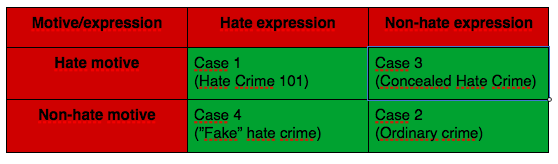
For illustration, consider the table below. On the one hand, we have the question of motive. Let’s simplify matters and say that an act is either motivated by hate or not motivated by hate. On the other hand, we have expression and again: hate expression or non-hate expression. In the table, we find two relatively easy cases, and two difficult ones.
The easy cases
1) Hate Crime 101 In the top left, we find a hate motived crime expressing hate. Painting a swastika on the wall of a Jewish cemetery, say. This is a clear cut case of a hate crime.
2) Ordinary crime In the bottom right, we find the non-hate motivated, non-hate expressing crime. This is not a hate crime. (There is an added dimension not considered here: whether the hate is perceived or not. This is independent of the other factors)
The difficult cases
3)”Concealed hate crime” In the top right, we have a case where I’m motivated by hate, and I select a victim representing the group I hate. But I make it look like an accident, or am persuasive in arguing that my motive is greed or something else. In this case we have the two normal conditions ”crime” plus ”hate motive”. What we don’t have is hate expression. This, of course, means that we have no evidence of a hate crime. But is it still one?
4)”Fake” hate crime In the bottom left, we find cases where the means used for the crime has all the hallmarks of a hate motivated attack, but the motive is something else. To create a diversion, say. Or, even more poignantly: my motive may be to cause as much harm as possible, and I’ve decided that a racist-looking attack is the best way to cause harm and societial unrest.
What matters, motive or expression?
Let’s concentrate on 4). 4) may seem just as bad as 1). There are two lines of reasoning behind that statement. First: if what makes hate crimes worse than other crimes is that they (tend to) cause more harm than other crimes, then 4) is clearly as bad as a ”genuine” hate crime. If the victim and the victimized group thinks it is a hate crime, the same sort of emotional pain, insecurity and suspicion arise. Second: if what makes a crime a hate crime is the motive expressed, rather than the actual motive, 4) is a hate crime, and thus, trivially, as bad as a hate crime.
Taking expression to be essential to hate crime, and thus treating 4) as an example, has certain benefits.
If we think that bringing motives into legislation messes things up, legally and evidence-wise, focusing on expression – by definition publicly available (although it might take som decoding) – is a good replacement. An improvement, even.
We have other options, however. 3) May be a hate crime, but not as bad as 1) and 4). 4) may be as bad as 1), but not a hate crime. Alternatively: if we think 1) is worse than 4) motive may make things even worse. If expressing hatred cause the extra harm, this is one aggrevating factor, but actual hate may be another. We then have three conceptually distinct versions of hate crime – mere expression, genuine expression, and concealment. We thus have the conceptual means to justify different punishments for each of these.
On the badness of motives
I mentioned two cases of ”fake” hate crime. First: I want to cause a diversion while I commit yet another crime, say, or I want something to keep the media attention away from other affairs for a while. This is sneeky, cynical even, but does not make that part of my criminal activity worse. But what if my motive is that I want to cause as much harm as possible? I don’t care about the victims race, I only care about them as ”vehicles of harm”. If I could find some other means of causing even greater harm, I would. This sort of sadistic, yet ”equal opportunity” motive seems on the face of it to be as bad as hate motive. If motives matters, then, and Hate Crime legislation suggest that it might, then we may have to open the door for other punishment enhancements. This, the critics argue, is a dangerous door to open. We may certainly make the moral case that certain motives are worse than others, but this may be one moral value that should not carry over into legislation.
Putting our focus on expression, rather than motive, fits the Hate Crime category into a classic conception of the law as dealing with what people do, rather than with what they think or feel.
The importance of unconscious prejudices
23 maj 2011 | In Crime Ethics Hate Crime media Moral Psychology politics | Comments?
According to the expressive theory of punishment, the main function of punishment, as of law itself, is to express the values and norms of a society. To insist on certain kinds of behavior, and to disparage others. Ideally, the laws reflects the values of the people currently making up that society, as well as those tested through time, by experience and debate, from the original lawgivers (the drafters of the constitution, say) onwards. When you commit a crime, the punishment tells you and others something about how society feels about it.
When it comes to Hate Crimes, this aspect is very important: Not only do we express norms that prohibit assaults, but we prohibit assaults motivated by, and expressing, prejudice. (In fact, a case can be made that it’s the expression of prejudice, and not its motivation, that make hate crimes worse). Even if we do not punish prejudice as such – we have other ways of expressing that norm – we punish its manifestations. And part of the motivation for doing so is to disparage prejudice as such. We could say that we punish the criminal for the hate-motivated assault, thus expressing a norm against such acts, but the punishment also sends a message against hate/prejudice in general.
Now, does hate crime legislation reflect the values of society? Are people that committed to tolerance and diversity?
The point of telling the criminal what we think is presumably linked to his/her current beliefs. So what does the hate criminal believe? What do the racists among us believe about the attitudes among the rest of us?
Legislation, government and NGO campaigning and at least some media content explicitly express commitment to diversity and resistance to racial prejudices. I take it that most ideological hate criminals realize that they are a minority, and that is part of what makes them dangerous – they are in the minority, feel threatened, disregard certain societal values and believe that they are in the right. Telling them that hate crimes wont be tolerated is hardly news, and they are unlikely to care. The expressive function, then, would be failing with regard to the criminal, but perhaps succeed with regard to the broader population.
Some racists presumably believe that, in fact, most people agree with them, even if they (we) don’t quite realize it. They blame political correctness for our current liberal and multiculturalist ”opinions”. This is very likely a persuasion that drives current populist right wing politics. They believe they only need to stir the inner racist in all of us, and that people, when it comes down to it, actually agree with them.
I’m pretty sure they are wrong about our conscious values. But are they wrong about us altogether? Among others (and more forcefully than most) the psychologist Jennifer Eberhardt argues that our prejudices are often unconscious and even at odds with what we explicitly believe. Even people who don’t associate black people, say, with criminality, tend to be primed by viewing black faces to more quickly recognize images of weapons, for instance.
If such findings reflect a broad societal phenomenon, we may ask what our values are, and how deeply committed we are to tolerance and diversity. Most of our prejudices never makes it to our conscious minds, but they still influence our judgments and behaviors. Without noticing it, tend to look for evidence that confirms our unconscious beliefs, and disregard others. This is why it is so important that even the most confirmed enlightened mind among us take a look at not only the content of their beliefs, but the inner workings of their decisions and behaviors. Most votes for the right-wing parties are not directly motivated by racism, but by the rationalizations that unconscious racism make us more likely to accept.
That a belief is unconscious does not mean that it reflects a deep fact about us. Quite the contrary – the test of whether an unconscious belief is ”truly ours” is to see what happens when it becomes conscious and tested against evidence and other beliefs. Do our conscious, considered values take precedence? Or do we adjust them to fit it our previously unconscious beliefs? What does happen when we become aware of such prejudices presumably depends on further psychological factors, but also by situational factors. Its uncomfortable to face ones failings, so perhaps there is a bit of pressure to deny that it is a failing. If people around you have a theory and a political program that incorporate your prejudice, there is some appeal in accepting that theory and that political program. It’s very important, then, that we have the means to address these prejudices when they surface, and someway to work with them.
If we are serious about our commitment to diversity and tolerance, we need to confront prejudices on all levels, and express that commitment in no uncertain terms in order to counter the populist appeal mentioned above. As has been remarked for instance by George Lakoff, liberals rarely want to address the unconscious by unconscious means. We are suspicious of such manipulation, and prefer the open and honest debate and believe that ”the truth will set us free”. But it’s much preferable when our values reflect our dispositions and emotions all the way down, when we not only believe and treat people of different races that they are equal, but instinctively react that way too. This may mean a lot more work than mere conscious conviction involves.
Does expressing our commitment to these values by enhancing punishment for hate crimes have an impact on unconscious prejudices? Or does it move our attention from the Reasons Why we should not be biased to Reasons having to do with fear of punishment? If it matters what the reason is why a criminal commits the assault, does it also matters why someone refrains from committing one? These are questions for another post.