Charleston – on hate crimes, terrorism and oppression
25 juni 2015 | In Crime Ethics Moral Psychology Philosophy of Law politics Psychology | Comments?First, there are two initial question regarding how to categorize this event: Was it a hate crime? And was it an act of terrorism? The answer seems to be straightforwardly ”yes” to both. Statements reportedly made by the suspect, the symbols he wore, the choice of victims and place, the reported premeditation, etc. all speaks to this being a racially motivated crime, i.e. a hate crime as well as a crime committed with the intent to bring about societal change or, rather, to stop societal change, or to bring things back to the way they were, i.e. an act of terrorism. I will put most emphasis on the hate crime angle, as it is my area of expertise.
Hate crime. The Charleston case is one. On nearly every conception of what an hate crime is, if current information stands, this qualifies as one. Some commentators has said that we need to await the result of the full investigation, and that is always a good idea, but it would be surprising if that investigation would undermine what seems to be a blatantly clear cut case. There are a number of hate crime conceptions, that only partly overlap. The most common idea is of hate crimes as distinct by motivation, i.e. the reason why the perpetrator committed the crime. But in fact, many jurisdictions interpret hate crime as a case of intentionally selecting victims from a protected class, and puts less weight on the reason why the crime was committed. This is an advantage in two ways; it does not require proof of motive, and it does not rely on the controversial notion of punishing motive. A third conception understands hate crimes as defined by intent; the intent to strike fear in the targeted community, for instance. On this account, hate crimes are more or less a species of domestic terrorism. A fourth identifies hate crimes as crimes expressing a certain message to the targeted crime. (The expressive account has however been deemed unconstitutional in the US due to its conflict with the 1st amendment). The Charleston case seems to qualify as a hate crime on all these accounts. It seems to be hate motivated, the victims and place were choices because of their racial significance, the intent was (apparently) to send a message and to instigate race war.
That being said, South Carolina does not have a hate crime law. This in itself is worthy of note. The development of hate crime laws in the US was preceded by the civil rights movement, and is generally held to have the differential treatments of former slaves as second-class citizens as its background. The fact that South Carolina has not taken this measure, in conjunction with factors like flying the confederate flag and naming streets after confederate generals, means there is a long way to go. That SC does not have a hate crime law is not the end of the matter. The case can, and it looks like it will, be run as a federal case. Since the Matthew Sheppard and James Byrd Jr Hate Crime prevention act was signed into law in 2009, federal authorities have extended abilities to handle cases the states are unable or unwilling to take.
This is important for two reasons. First, the federal government having to step in in order to make justice possible in a race based case in a Southern state says something about how America is divided. Second, in order for this to be run as a hate crime case, it must be run on a federal level. But hate crime laws are penalty enhancements laws. And given the gravity of the case, it is quite possible that the penalty, if it had stayed in South Carolina state court, would have been the death penalty. In fact, the probability that it leads to the death penalty in a federal court may be lower. Which means that in order for it to be judged as a hate crime, it may lead to a lower penalty being given. On this account at least, this case can become legally interesting.
Why are hate crimes worse than other crimes? This was a massacre, a mass murder, an act of terrorism. What is the significance of naming it a hate crime? As I said, hate crimes laws normally take the form of penalty enhancement statutes. This is because they are deemed worse than ”parallel” crimes, i.e. similar crimes absent the hate element. There are a number of reasons why, some having to do with the discriminatory nature of these acts, others with the maliciousness with which they are being committed. The most common account is harm-based, however. Hate crimes, according to influential scholars like Paul Iganski and Frederick Lawrence, hurt more. The primary victims typically experience more psychological harm when the crime is hate motivated. In a case like this, when the outcome is death, that is not relevant. But the additional harm also exist on the victims group and on society in general – it may, for instance, worsen the relations between groups. Both these accounts are relevant here; the targeted group is reminded of the risk it is at, and the tension between groups hightened.. Indeed, that was the expressed intent of the offender – to start a race war
Before moving on, lets just say this on penalty enhancements: Say he is sentenced to the death penalty, and that penalty enhancements cannot come into effect. Still, it is not pointless to treat it as a hate crime. Indeed, many victims and victimized group say that the penalty enhancement is less important than is naming the motive in these cases. Recognizing and condemning these types of crimes is the more important part. Hate crime laws has an expressive function.
So, was this an act of terrorism? Again, the answer seems to be straightforwardly ”yes” by most definitions. But perhaps not all. What makes an act of terrorism is the intent (together with means reasonably fit to purpose) to cause fear and force societal and/or political change. According to one statement, Roof wanted to bring about a race war, which is certainly one way of doing that.
What complicates matters is that Roof, much like the Norwegian terrorist Breivik, seems to be a conservative terrorist, i.e. one that wants to stop change. Or to change things back the way they were. And this may be one of the reasons why he was not immediately and universally being called a terrorist. The ”typical” terrorist is someone somehow alien to the system which he/she wants to change. The thing that people keep pointing out is that this act was the extreme expression of white supremacy, and that this ideology is actually not that alien to the dominant culture. Many commentators that wants this branded as an act of terror, also thinks that the racism expressed is not uncommon, indeed that these attitudes are entrenched in society, part of the norm. There is some tension between these two aspects: Do we want to portray him as somehow normal, which means that the problem is much, much bigger than the risk of these kinds of attacks? Or do we want to describe him as something ”other”, something alien to our system? The reluctance to accept something entrenched in ”our” culture to be capable of terrorizing that same culture is probably one of the reasons we turn to questions about mental health in these cases. Why would a person congruent with the dominant culture in what is being described as a racist society otherwise go to these lengths, take this sort of risk? In the absence of a deep cultural divide between him and us, we need mental health issues to distance ourselves from a man capable of such heinous crimes.
The reasons why it might not be understood as terrorism is that we do not yet know whether there is any clear organization behind him – which is typical of what people think of as terrorism. Of course, the need for such organizations to facilitate acts of terrorism is considerably weakened by the internet, which make it possible to cherry-pick an ideology, a support base, and a methodology to suit you. Secondly, that the criminal is (as Åsne Seierstadt stated in her book about Breivik) ”one of us”, i.e. not that different from normal members of the population. This is significant as it means there is no discernible ”other” to direct retaliation towards. Terrorist threat is ”supposed” to come from outside, from people with no other route to a position of power. Rather than describing it as an act of terrorism, then, it could be branded as an act of oppression.
The significance – Charleston as a symptom
What does this act mean? What does it signify? Is it a sign of things getting worse, and this is just a symptom of growing racism and racist rhetoric? Or (counter-intuitively) may it be a sign of things getting better? Racist offenders may find their justification in others expressing the same views. But they also find their justification in thinking of themselves and the society and values they care about as being somehow threatened. While hate crime criminals are often part of the majority, it is when that majority think of themselves as loosing their privilege that the need to commit a crime to keep that privilege arise. Lynchings were often a reaction to former slaves behaving in a way that former slaveowners and other whites thought of as unacceptable for a black person. Similarly, hate crimes are often understood as a response to people of the hated group stepping out of their place, and there being no other way of putting them back. Segregation, privilege and power means rarely having to worry. But, of course, privilege should be threatened. People like with the beliefs that Roof seem to have should be feeling threatened, because the order they want should be collapsing. If this is how it works (note that this is just a hypothesis), a rise in these types of crimes is likely to occur as things becomes better at a more everyday, ”structural” level.
On caricatures, freedom and the nature of assholes
13 januari 2015 | In Comedy Emotion theory Ethics Hate Crime media Moral philosophy Philosophy of Law politics Psychology Psychopathy Self-indulgence Uncategorized | Comments?I have to admit, I’m not overly fond of caricatures. Never have been. I guess sometimes they manage, just like a good metaphor does, to capture something important about its object that was not as obvious before. The thing that a caricature brings out about the object is usually intended to render it ridiculous. Most things are partly ridiculous, of course, it’s almost never a useless way of viewing a thing. But it becomes particularly useful if the thing, or person, or group, is in power, is pompous, is revered to an unreasonable extent. It becomes less so, even harmful, if the thing or person, or group, is already despised, disenfranchised, already treated as ridiculous.
The reason why I’m not overly fond of caricatures, or metaphors for that matter, is that they rely on putting emphasis on certain things at the expense of other things, and the result, the ”translation”, as it were, depends on whether that serves to correct the received view in order to reflect the actual importance of those things. Caricatures have a history of ridiculing power, and that history is well-rehearsed these days. But they also have a history of serving power. Of dehumanizing people it deems of less importance, which makes those people even easier to disregard, or even to kill.
There is an argument that says that we have freedom of speech in order to protect precisely the sort of statements that we do not like. This is spurious. It may be true that the extent of freedom of speech can be measured by exactly how offensive, vitriolic, hateful, debasing, threatening expressions that it allows, but it hardly seems to be the point of having freedom of speech. Some people will say that freedom is a value in itself. Others, like the more often quoted than read J.S. Mill, say that freedom of speech is an instrumental value, which serves a function. And it can be limited when it fails to serve that value. On this account, we can say that freedom of speech is a matter of costs and benefits. The offensive can occasionally be a benefit, the hateful very rarely is, but we may want to preserve the right to make hateful assertions because the total value of relatively unregulated speech is positive. The benefits may outweigh the costs. (It should be noted that this analysis could, and, I believe, should, adjust for fairness. If the costs and benefits are unfairly distributed so that the worst off bears the greatest burden, the cost may be unacceptable even if it is outweighed in absolute terms). Hate speech laws tend to draw a line between the offensive (which is allowed) and the hateful (which is not), but some legal scholars and a lot of libertarians believe this distinction fail to track anything of moral importance.
Now. In moral philosophy, the notion of an asshole is quickly turning into a technical notion of considerable use. An asshole is a person that does not infringe on other peoples rights, but does everything he/she can to reap the benefits for him/herself, and nothing to help others. It is the kind of person that uses freedom of speech to say all the worst things he/she is allowed to, while contributing nothing to a worthwhile discussion. The behavior of such people tend to be on the cost side in the cost/benefit analysis of a right. Assholes are on the cost side, and when they become too many, the instrumental value of certain freedoms decreases. At the same time, the fact that we tolerate them (even encourage them in certain contexts) may be a testament to the strength of our society, our resilience. Assholes also serve the considerable function of demonstrating the gaps in our systems and institutions.
I’m going somewhere with this. I have not made myself familiar with the works of Charlie Hebdo. I don’t know french, and I’m not sufficiently familiar with the cultural and political context. If I understand things correctly, their tendency has been to make fun (if that is the right word) of power and pompousness in all it’s guises. It certainly is no straightforward instrument of power. But equal treatment does not amount to equal effects, especially when the people and groups treated have different social standings to begin with. Some of their work may render things ridiculous that we all benefit by viewing in that light. Some of it may serve to dehumanize and ridicule people that are already being discriminated against, whose social standing in the context is low. The latter is an unmitigated cost, and it is the work of assholes, in the technical sense described above. Caricaturists will often tend towards asshole-hood. And it is possible that they should, that it is for the good that there are people, and publications, like that. But it would probably be unbearable if we were all like that. And while the extent of free speech may be measured by the worst things it allows, the value of it must be measured by the best things it allows that would otherwise have been banned.
Some hate crimes are worse than others
18 december 2014 | In Crime Ethics Hate Crime Philosophy of Law Psychology | Comments?A tale of two hate crimes
Imagine that I am physically assaulted on my way to work because of my membership in some of the groups to which I belong. The white, the middle-class, academics, the city-dwelling, the fairly tall, the heterosexual or what have you. Imagine what, in this very unlikely event, would happen to me, given that I survive the assault and am not hospitalized.
I would report the crime to the police, who would hear my story and do whatever it could to track down the assailant. Then I would probably call in sick, stay at home for a some period of time, be afraid to go out, have difficulties sleeping etc. The social security system, and the social ”safety net” would soon spring into effect, I would receive a large share of my salary, my employer is very understanding, and would keep in touch but not press me to come back to work. My family and friends would gather round, make sure that I remained safe, fed, got the opportunity ta talk things through. I may never regain my complete sense of security and confidence, and may fear renewed victimization due to the manifested presence of violence inducing bias towards me in some capacity.
Now imagine a person of Roma origin from eastern Europe, begging outside a convenience store in the middle of the Swedish winter. Imagine what is unfortunately not that unlikely, that person being attacked by a hate motived assailant. What would happen then? First, that person may hesitate to contact the police, due to earlier encounters (eviction from a camp, say), fear of being harassed, registered, of being picked up on the police ”radar” as someone associated with crime and, minimally, not expecting to be taken seriously. So there is, at the very least, a hurdle to clear for any kind of social security or victim support to kick in. Further, there is very little by way of a home for this person to return to, and there is no social security, no compensation for lack of income. The situation in the homeland, which it is expensive to get back to, is not much better. There may be family and friends around, of course, but these too have to earn their living in this makeshift fashion, and they are equally at risk of being targeted.
Risk and disadvantage
Now, there are two very relevant differences between these two cases.
First, the latter sort of attack is much more likely to take place. Even when it doesn’t, people of Roma origin, particularly recent arrivals in the exposed situation of being forced to spend time begging, live with the constant risk of being assaulted, and with the constant presence of reminders of this risk. (Verbal assaults, campaigns from populist right-wing parties). Whereas I may receive a handful of group-based insults over a life time, these people receive them every single day. Besides the fact that such assaults, when they occur, have terrible consequences, they also serve as an reminder of the constant risk of assault of which they are manifestations.
Second, the difference in impact described above means different amounts of harm caused. The fact that I have access to a marvelous social safety net makes it the case that a lot of resources are concerned with minimizing the harm of such an attack. This is hardly present at all in the case of the Roma immigrant above. This is to say, they are at an disadvantage in almost any conceivable way.
Some hate crimes are worse than others
Committing a crime against a person belonging to a thus disadvantage group is, arguably for that very reason, worse than committing a similar crime against me. Doing so because they belong to that group betrays a particularly heinous motive. Both crimes above are motivated by hate/bias, but the latter is clearly worse because of the relative social standing of the victims. If so, it is not just the hate that matters, but the fact that this hate purposefully targets people that are already at a heightened risk for this sort of attack, who lack comparable resources to minimize harmful effects (including reduction in income), and that have a minimum of support when being attacked.
It is bad enough to attack these people at all. To attack them because of their membership in this group that is thus at disadvantaged, is simply beyond the pale.
Hate crimes and harm
In a forthcoming paper (in a symposium section of the Journal of Interpersonal Violence, edited by me and Christian Munthe), Paul Iganski and Spiridoula Lagou point out that hate crimes do tend to hurt more than other crimes, but that some hate crimes hurt more than others. This is an important, and yet under-researched, matter. If the seriousness of a crime is proportional to the harm involved, such matters are important. In particular, it is important for which groups should be included, and be made a priority, in the enforcement of hate crime legislation. The sort of contrast I described above suggest that it is not simply the hate/bias element that makes these crimes particularly serious, even if that is a contributing factor; it is also the fact that some groups are more frequently targeted, and that some groups are at a disadvantage when it comes to resources to cope with victimization.
Inexcusable racism
24 juli 2014 | In Emotion theory Ethics Hate Crime media Moral Psychology politics Psychology | Comments?Everyone’s a little bit racist. Basic cognitive functioning relies on generalizations, after all. Unwarranted initially, in order to get off the ground, and then more or less supported, or rejected, or revised by experience, by evidence. Slightly less basic cognitive functioning requires that we adjust our generalizations in the face of evidence. We adjust our explanatory categories, we fine-tune and narrow in on something that starts to look like likelihood. Or, rather, we do this when there’s sufficient reasons to do so. And those reasons are not just epistemological, they are to a large extent pragmatic. Most of us are lazy thinkers, and all of us have limited time to spend on adjusting categories. We only do when it’s useful for us to do so, or when we have the time and interest to do so at our leisure.
We assign significance to superficial differences like skin color, mode of dress, language, gait, because superficial differences are what signifies internal and explanatory differences when no other information is readily available. (To be fair: superficial difference often DOES correlate with less unimportant things.)
Prejudices are explanatory shortcuts, and quite often they serve us well. Sometimes by being dead-on, otherwise by knitting us closer together with others with similar needs, who jumped to the same unfounded conclusions about the explanatory order of things. The prosocial function of shared false beliefs should not be underestimated. Organized religion springs to mind.
People are, by most accounts, naturally geared towards bigotry, at least under the circumstance of groups competing for resources that seems to have prevailed through a significant part of our formative evolutionary past. The thing to explain is not that we are bigoted, but that we occasionally stop. (Even so, what categories matter, and how to assign value, is, of course, learnt. The tendency is present in the cognitive default state, but needs triggers and particulars to get underway and be filled by content. A person born into a truly egalitarian world would arguably have the tendency to assign significance to the superficial, but lack most of the triggers to do so, and the guidance to do so in any particular manner. Bigots, if they were still to develop, would be of a much more idiosyncratic ilk).
We may be partially excused for being racist, then, as it is in our nature to make a big deal out of differences, and we can often find at least some evidence to back a prejudice up. We are likely to do this, as our prejudices are often at least partly emotional in nature, and we are likely to go looking for confirmation, rather than rejection, of the rationality of those emotions. Emotions too have an evolutionary function, as indications we do well to trust when information as the the value of things is scarce. Awkwardness in the face of the unfamiliar calls for post hoc rationalization (ironically, the pressure towards a racist explanation of that awkwardness increases when there is a reluctance to self-attribute prejudice).
Yet we do blame people for being racists and are presumably right to do so. Why? Because we have every opportunity to revise our first impressions. The evidence as to the irrelevance of these superficial differences is so overwhelming, and the case for the basic equal value of persons is so much stronger than any alternative account, that there is really no excuse if you’re an adult, intelligent person living under non-warlike conditions (people at war, or under extraordinary stress, may sometimes be excused).
The point is that people should be blamed, not merely for harboring racist (and other, avoidable) prejudices, but for failing to revise them in the face of evidence, and for the failure to look carefully enough for evidence that falsifies that prejudice. In many cases, the reason for such failures is nothing more sinister than basic cognitive laziness and self-interest.
There exist, of course, a skeptic safe haven for the bigoted, and it consists of distrust in the sources of evidence. If you believe that, say, the liberal elite has an agenda to mislead concerning the nature and character of the groups you disfavour, you may well protect your prejudices against such challenges. The strategy is fundamentally flawed, as it depends on not adopting skepticism in equal measures to other sources of information, like the sources you use to entrench and confirm your pre-existent prejudice. But the model provides some light when it comes to explaining why some people remain bigoted. It also shows the depth of the problems caused by societal distrust.
On extreme and everyday hatred
13 november 2012 | In Crime Ethics Hate Crime politics Psychology | Comments?The locus of the problem
In policy documents and in the scholarly literature, the idea recurs that the contemporary problem with xenophobia and racism is not primarily located in extremist acts of violence but rather in prejudices prevalent in the general population, and primarily expressed in minor acts of discrimination and behaviors well below the threshold of the criminal. These acts and attitudes when combined, when systematic, accounts for many avoidable problems facing society in general, and targeted groups in particular, and are quite clearly a proper target of policy measures. In addition, these widespread attitudes are often held (see Barbara Perry’s 2001 book ”In the name of hate” for instance) to provide the background conditions and justification for more severe hate crimes. Hate criminals may take everyday racism as their mandate to offend
The inclusiveness of the legal definition
Hate crime and hate speech laws target, depending on jurisdiction, more or less extreme versions of discriminatory actions. In the hate crime literature (See Iganski 2008 and Perry 2001) a case has been made in favor of an inclusive definition of hate crime, not limited to cases of extremist violence, but including more or less any crime in which a bias element plays a central role. The argument in favor of such a definition is usually made on the grounds that less extremist, less obviously racist, yet still hate motivated crimes, have the same sort of particularly harmful impact as extremist crimes has, and this is the morally relevant distinction between hate crimes from other crimes. Focus on the obvious cases can make us blind to the prevalence of these relatively ”minor” crimes , and can thus have a detrimental an impact on victims tendencies to report and on authorities tendency to respond. It may also make us blind to the occurrence and impact of non-criminal covert racist behavior.
Harm and Prevention
Hate crime and -speech laws and statutes are often justified on the basis of the harm caused by these crimes. The justification may be retributory, but for the most part, the assumption and justification is that punishment has a preventive function. It is supposed that legislation will limit the occurrence these crimes, and of their harmful effects. It is also viewed as an expression of the state’s commitment to equality. It is presumably assumed to have a discouraging influence on prejudices in general. It’s to the latter function I’ll now turn.
Wider effects on prejudice
The point is this: even if the non-criminal, less obviously xenophobic expressions of prejudice is the true locus of a societiy’s xenophobia problem (and the source of target groups remaining disadvantaged), punishing the more extreme manifestations have effects on the prevalence of the attitudes thus distinguished as aggravating. This, presumably, is their rationale. There is little point in the criminal law expressing commitment to equality if the predicted effect is not a reinforcement of support of equality.
Are hate speech laws effective?
In his 2004 book The Hateful and the Obscene, philosopher Wayne Sumner argued against hate speech laws on the grounds that they are largely unnecessary. The kind of racist expressions that presumably warrants criminal sanction in this way is likely to be counter-acted by public opinion and reactive support for victimized groups. Society would indeed be worse if racist speech would stand un-opposed, but it isn’t. At least not for established minorities (which tends to be the ones protected by this sort of legislation). This, of course, is part of the classic liberal defense of the first amendment: the solution to hate speech is more speech, not restrictions on speech. Hate speech legislation, on this view, is not effective and thus lack justification. Indeed restrictions are likely to make would-be offenders self-righteous and martyr-like and may thus exacerbate the problem.
The extreme and the everyday
The relation between extreme/criminal acts and speech and everyday xenophobia is crucial to policy and legislation pragmatically construed. If hate crime and – speech laws may in fact make things worse in this way (as argued in Jacobs and Potters seminal 1998 attack on hate crime legislation) and it is the widespread prejudice in the non-criminal population that accounts for the severe impact of these crimes (the impact of hate crime is presumably more severe in a society where the victim is also subject to widespread prejudices), we have a dilemma. If the public reply to hate crimes is diminished prejudice in the general population, each hate crime is likely to diminish the conditions for their particularly harmful impact. While this should not be counted as a mitigating factor, it does rather undercut the rationale for it being an aggravating factor. In particular if the attitudes that actually determine the impact is not that of the offender, but that of the general public.
One mechanism by which punishing hate motivated speech and acts may have a detrimental effect is, as stated in the introduction, if it means we ignore and accept everyday racism as relatively unworthy of attention. Hate crime legislation, especially when it is not enforced, can be a relatively cheap way of ”taking prejudices seriously”. It can express commitment to equality while not making a commitment to work towards equality.
The case for legislation
The argument that hate crimes and -speech is naturally counteracted by public reactions, because tolerance is the prevailing attitude in most modern societies, does not necessarily undermine the case for legislation. In fact, it may offer a further argument in favor of these laws: Legislation (plus prosecution and sentencing) is part of the public ”reaction” to these crimes and to this type of speech. The public condemnation of these acts (be they acts of violence or of speech) means that they are held to warrant extra punishment. The laws are legitimate. The support offered to victims should not just come from public reactions (which a fickle and too dependent on ones groups prior standing) but from legislation that ensures equality of consideration.
The empirical question, crucial for policy
Do laws (and prosecutions, sentencing etc) have a reinforcing impact on attitudes thus expressed? This, is an important question. And it would seem to be an empirical one, the settling of which depends on careful (and methodologically very complex) evaluations. Do effects on general attitudes depend on an inclusive hate crime concept, for instance, showing that non-extremist and non-violent crimes can be hate crimes too? Does it depend on law-enforcement making these crimes their priority? Or might such a policy result in a worsening of the situation, by putting the emphasis on group conflicts? These, as I say, are clearly crucial question to answer if hate crime- and speech legislation is based on and ultimately justified by their role in, a general anti-prejudice policy project.
Deterrence and rehabilitation
7 maj 2012 | In Crime Ethics Moral philosophy Moral Psychology politics Psychology | Comments?
A suitable mode of thinking when it comes to legal punishment is in terms of functions. What functions are punishments supposed to perform? Let’s restrict this discussion to prison sentences for now, but assume that it applies to other forms of punishment as well. In the literature, four functions are easily distinguishable. The question I’d like to raise is whether these functions can all be performed by the same sort of punishment, or if they come into conflict.
1. The first function is deterrence. A spell in prison is an unpleasant thing. At the very least, presumably, it’s time spent away from your friends and family, from your projects in the world outside. If you care about not being cut of from those things, staying out of prison is a good idea. Of course there are all kinds of questions about how much worse time spent in prison is in relation to your life outside but let’s leave that to a side for now and state this principle: In order to perform the function of deterrence, a punishment need to be in some way or another, unpleasant. Or at least believed to be so.
2. Another function performed by punishment is retribution. The offender have harmed someone, and perhaps harmed society as a whole as well. In order to settle this, some form of harm must be brought to the offender. This is supposed to satisfy some need of the victim, who has a grievance, and the punishment will somehow ”balance the scales”. Again, the punishment, it would seem, need to be in some way unpleasant. Unpleasantness is normally a bad thing, and bad thing distributed to people who commit bad acts, are good things, or justified, or whatever. I should point out that even if you (as I) do not think retribution provides any kind of real reason to impose a punishment, it is clearly one of the functions performed by punishment. If you’re (like I am) critical of it, this means that a policy for punishment that makes it less likely to perform this function is no reason not to implement that policy.
3. A third function is rehabilitation: The offender should benefit from the punishment in the sense improve. Change his/her ways. This function is backed up by reasons of prevention, just like deterrence is, but functions in a slightly different way. The idea is that offenders offends because of some mistaken factual or moral view, because of some mental problem (a very large portion of current inmates have some mental disorder) or lack of skills suitable to make a honest living. Now this function does not require the stay to be unpleasant. Indeed, it would seem that it should not be unpleasant. Or perhaps rather – it should be unpleasant for the criminally inclined features of the agent, but not for the agent as a whole. It should, in lack of a more specific idea to express, be rewarding to improve.
4. The fourth function is simply that of protection. I.e. storage. Keep the offender away from the public for a while, as he/she is proven to be dangerous. This implies nothing about how pleasant the storage facilities should be.
The Conflict
Let’s forget about retribution for know, and concentrate on deterrence and rehabilitation. Both aim to change behavior and to prevent future offenses. But there is this conflict – a deterrent needs to be unpleasant whereas rehabilitation may very well depend on being at least partly pleasant. Perhaps both functions may be performed if we have the idea that something unpleasant can be good for you. The unpleasantness of the stay in prison, then, would presumably drive home the message: don’t do this thing.
Is punishment about learning?
Indeed, it would seem that both deterrence and rehabilitation is about learning, where the latter includes more of positive reinforcement, and the former solely on punishment. Punishment, as we know, is rather effective when it comes to learning people to avoid something very specific (i.e. committing this crime and get caught doing it). It’s terrible at learning people why to avoid that behavior, in a way that generalizes. A sensible criticism of deterrence theories is that it provides offenders and would-be-offenders with the wrong kind of reason. Of course we shouldn’t hurt people, but not because we would be punished if we did. Providing an unpleasant punishment provides offenders with the wrong kind of reason not to reoffend. It’s extrinsic to the behavior we want to stop, which means it’s contingent on the irrelevant risk of getting caught. Rehabilitation, presumably, would concentrate on getting the offender to recognize the actual reasons why they should not harm people.
This function – to drive home the actual message about moral reasons – should primarily be performed outside of prisons, be taught in schools etc. Punishment, it could then be said, is about providing an additional reason for those who obviously don’t care about others. We know there are people who don’t care about us, and we need them to refrain from hurting us, so we better provide this reason or suffer the consequences. If we can’t ”rehabilitate” offenders, or merely if such offenders exist, this is fair enough. The problem, then, is how to have punishment perform both functions at once. It seems to be a problem that can only be solved if we let punishment depend on individual assessment. Justice, then, should not be blind to the character of the offender.
Two types of deterrence
An additional problem is the fact that the risk of an unpleasant punishment may be part of the most effective strategy to stop people from offending. But a rather more pleasant rehabilitative strategy would, perhaps, be more effective at stopping offenders from re-offending. Not by deterrence this time, but by making offenders aware of the real reasons, and also to provide them with better options and the skills required to take advantage of these options.
The function of the unpleasant
Is it essential that punishments be unpleasant? I’m not going to rule it out. Threats, implicit and explicits, are common in most forms of education. If you fail an exam, there is the threat of having to take the class all over again. It would be good for you, provided that the class is important, and you would be better off taking the class again than you would be getting away with your ignorance. But maybe you don’t see it that way, and that may very well be part of your motivation to study hard before the exam. It’s the wrong kind of reason, but, with a little luck (educators hope) that reason will eventually bring you to recognize the right reasons. Recidivism rates suggests that this does not work in current prisons. The first part, providing the unpleasant surrounding, might work and some deterrence take place, but the transfer from the wrong to the right kind of reason rarely does.
Who should be in unpleasant prisons?
Threats and punishments are signs of failures. Society has failed to provide the right kind of reasons, and must now cope by providing instrumental ones. If we can learn the right reasons not to hurt one another, we should be taught this by living among others. If we don’t, through no fault of our own, we should not be punished unpleasantly. This is a rather christian principle – if you have not been provided with the proper case for belief in God, Hell is not for you. Heaven isn’t either, not yet anyway, but you won’t burn. This strikes me as a sensible practice. But if we can’t learn, if we’re egoists or psychopaths, if we are people who can only see the point of refraining from a practice if there’s negative on our own well-being, then presumably prison should be an unpleasant place, something to be avoided, and rehabilitation would have no point.
One last point, before I end this (still very open) post. In order to deter, prison should perhaps be believed to be unpleasant. And, if rehabilitation has not worked, offenders should keep that belief when the get out, in order not to re-offend. But there is no reason for prison to actually be unpleasant. If the threat of an unpleasant stay did not stop you, there is no reason to actually give you an unpleasant stay.
Punishing causes
3 januari 2012 | In Crime Ethics Hate Crime Moral philosophy Moral Psychology Uncategorized | Comments?”Tough on crime, tough on the causes of crime”, remember? I remember very little of the substantive debate but I do remember that it spurned a debate on the use of non-committing slogans in political speech. The immediate appeal of slogans should not be dismissed as a mere trick, however.
There is a quite obvious and quite relevant issue hidden in the slogan: How does, or should, our approach to crime relate to our understanding of, and approach to, the causes of crime? Presumably our toughness or softness on crime should be modulated on the basis of our perception of the causes in question because clearly, all crimes do not share causal histories and clearly, this matters to how we assign responsibility.
Quite generally, causes are relevant to responsibility and to criminal punishment as punishment is meted out on basis of, and in proportion to, the harm agents cause. A highly valid defense to the allegation of murder is to say that you didn’t cause the person to die. Or, actually, accurately and more precisely: that you didn’t do it. To murder someone is not only to cause the death of another, but to do so while trying to do so.
The most obvious causal component of relevance to responsibility/culpability is the decision. We are condemned for the things we decide to do, and decisions have consequences. Reasons and considerations are presented to us, or thought up by us, and then we make a decision to act on some of them. We are then held responsible for at least the causal consequences that we had reason to believe would follow. But decisions are not where causal chains end. And while deciding to do something that will cause harm when there is no reasonable amount of compensation is surely blameworthy in it’s most paradigmatic form, it’s not the end of blameworthiness either.
Yet, there are further moral judgments to be made which goes beyond the decision. For instance: what considerations did you act on? How was the case for and against acting presented to you? Was it greed? Was it vengeance? And now the question becomes: can we add to a criminal sentence on the basis of pre-decision causes? We seem to be able to subtract from a sentence on basis of certain causal pre-cursors, such as ignorance or a mental episode. But can we add?
Now to the hate crime context. For theoretical reasons as well as practical ones further down the line, it’s important to distinguish between the reasons for the support of hate crime legislation and the justification of that legislation. My reasons to favor higher taxes may be that I would gain from it in the long run, but that’s not sufficient as justification as tax rates are not in place to satisfy my interests. It does mean, however, that I’m more likely to look for, and find, further reasons for higher taxes.
It’s very likely that support for hate crime legislation is at least in part grounded in the intuition that some pre-decision causes are worse than others. We dislike, and we are right to dislike, prejudices, vengefulness, greed etc. But it is not clear that we should punish on the basis of the moral objectionableness of pre-decision causes. Even when we are somehow responsible for having become bad people, we can’t be punished for being bad people, only for doing what bad people tend to do, and which makes them bad: harm. If there are other justifications, we should identify them. But we should be very clear that our acceptance of those justifications is not wholly founded in our independent, warranted, but legally invalid, moral stance. Or, of course, we must make the case that these pre-decision causes are reasonable grounds for punishment enhancement. Which means much more work.
Two lessons to draw from this:
1)We may maintain that decisions are where culpability starts, but that the picture is more complex then previously recognized. Decisions may be judged as worse not only on the basis of the harm intended, caused or risked, but on the considerations that was deemed sufficient for the decision to be made. To treat a prejudiced view as a decisive reason, then, is worse, for instance, than treating greed as such a reason because it is a worse reasons. Still, we are not punished for this reasons, but for treating it as a decisive reasons. (Leaving, for know, the question whether the cause and/or reason for our accepting this consideration as a (decisive) reason should influence the extent to which we are culpable…)
2) Pre-decision causes are clearly relevant for effective preventive measures. We should concentrate a lot of effort at counteracting them and the most effective means may not be punishment enhancement, or any other means available to the criminal law.
Being ”tough” on causes of crime doesn’t necessarily, or primarily, involve punishing people for having certain beliefs attitudes or dispositions, but effectively counteracting the conditions under which such beliefs, attitudes or dispositions arise.
There goes the neighbourhood
21 december 2011 | In Crime Ethics Hate Crime politics Psychology Uncategorized | Comments?
What counts as a hate crime?
Among the first questions you should ask when being introduced to a new category-concept is this: what does it cover? What qualifies as an ”X”? When given a fairly informative definition, you then quickly go on to fringe cases, and ask whether they qualify or not. This technique will make you seem polemic and lacking in seriousness. If you’re a decent philosopher, that’s at least partly true.
We need fringe cases in order to lure out the differences between theoretical models, and also to test the plausibility of these models.
Hate crimes, as we know, invoke a combination of factors, mainly crime, prejudice and the small but very significant and problematic notion of ”because of”. A crime is a hate one when it is committed because of a prejudice against a certain group (membership in which is based on some to-be-determined characteristic important to the victims’s, or somebody’s ”identity).
Now, it’s important to note that committing a crime because of a prejudice against a group, is more narrow than committing a crime because of group membership. I may believe (rightly) that the elderly are less able to catch me, running from the scene of the crime, and therefore target them. According to the so called ”victim selection model” for hate crimes, this might qualify simply because group mebership was part of the reason why I picked out this particular victim. According to the animus-model, it wouldn’t count unless I also held some negative and unfounded views about the elderly and that was part of the motivation for the crime.
The victim selection model allows for cases where the perpetrator has no prejudice, and prejudices in general do not enter the explanation why the crime took place. Semantically, this puts the label ”hate (and bias) crime” in question. But consider a further case:
A person assaults a group of immigrants that have recently moved in to the neighbourhood. The reason is that he/she (rightly) thinks that the arrival of immigrants have lowered the economic value of his/her house, and thus intend to scare them into moving away. Let’s imagine this is the sole reason, and the perpetrator can deny any prejudice by saying that he/she would’ve assaulted anyone whose presence in the neighbourhood had that effect.
What does the animus model say? Well, no animus is present, so this seem not to be a hate crime. The victim selection model, on the other hand, would presumably rule it in.
However: the peculiar feature of this case is that the crime is still committed because of prejudice. It’s just not the prejudice of the perpetrator, but that of the potential byers of property. On one interpretation of the ”because of” clause in the hate crime definition, then, these sorts of crimes would count. In many respects, these crimes seem to be at least as shady, and in some sense cowardly, as crimes committed on the basis of a prejudice that you have yourself. They presumably do as much damage. But should they count as hate crimes?
It depends, you might say (and rightly so), on the proper analysis of the
because of
. It’s just that this analysis depends on the plausibility of what’s included, like the fringe case above. And that in turn depends on the moral foundations of hate crime legislation. A question that, as reader of this blog may have noticed, is far from settled.
Hate Crimes and the Unfair Distribution of Harm
3 oktober 2011 | In Ethics Hate Crime Moral philosophy politics | Comments?Hate Crimes Hurt More is the title of Paul Iganski’s 2001 article in the American Behavioral Scientist, and while this title could have done with an added question mark, subsequent work by Dr Iganski and others offers ever increasing support for the central claim. The harm caused by hate crimes is not just the harm done to the victim, but to the group membership to, or association with, which was why he or she was targeted, and to society as a whole. Calculated in mere aggregative terms, then, there seem to be plenty of reasons to prioritize hate crimes, to prevent them from happening and to help victims (primary, secondary and tertiary) cope with the consequences. It is important that we work out why hate crimes hurt more. The reasons may be extrinsic to the crimes in question, for instance, and thus be addressed by other means than criminal sanctions. So far, so utilitarian, so within the wrong-doing – culpability paradigm. Hate Crimes are worse than other crimes if (and only if) they tend to do more harm.
Hate crimes Hurt Less?
Now, while there is evidence for the claim that HC’s hurt more, it is far from complete, and as data collection is far from standardized across nations, it’s hard to sustain the universal claim. So now I’m going to make a bold suggestion: Hate Crimes actually hurt less and that’s what’s wrong with it.
If we focus on the harm done to the victim’s group, there seem to be at least two mechanisms at work:
1) If people like me are targeted, I’m more likely to be next.
2) I feel more empathy for people like me, so when someone with whom I share an important characteristic, I feel it more.
This means that if another group/characteristic is targeted, I’m unlikely to be targeted, and I won’t, presumably, care as much. I guess most people feel like this about gang-related violence. If totally random acts of violence occur, everyone would, presumably, feel equally threatened and thus the harm would be even greater (even if the likelihood of you being next would be inversely proportional to the group within which the random violence occur).
The suggestion here, then, is that hate crimes hurt some people more than others. And that’s what’s so wrong about them. It’s discriminatory, and prioritizing hate crimes would be an act of distributive justice, independent of claims about the extent of harm caused by these crimes. This is in line with an Harel and Parchomosky (On Equality and Hate, 1999) who claim that recognizing the moral significance of hate crimes in criminal law depends on extending the wrong-doing – culpability paradigm with what they call the Fair protection paradigm.
Equality vs Utility
This brings to the surface a very basic conflict in moral and political philosophy: It’s uncontroversial that harmfulness counts, but does equality of distribution of that harm (and benefits) count as well? If it does, there can be conflicts. Making hate crime a priority may be very costly in terms of police efforts, for instance, and require resources to be taken from investigations addressing other crimes. In principle, we can have a situation where a smaller number of crimes, and a lesser aggregate of harm, takes place but a disproportional portion befalls a minority of the population. That scenario comes in roughly three types, testing our commitment to fair and or equal distribution:
1) The number of crimes and amount of harm befalling the disadvantaged group is smaller than it would otherwise have been – I.e. the total harm is smaller, and the harm caused to the group is smaller than in the original scenario, but the proportion carried is larger. Preferable in absolute terms, not preferable in equality terms.
2) the number of crimes and amount of harm befalling the disadvantaged group is the same, but that of the majority is lowered.
3) The number of crimes and amount of harm befalling the disadvantaged group is larger than in the original scenario.
Our commitment to equal distribution is shown by which of these we find preferable to the status quo, or if none of them are. If, in a Rawlsian spirit, you want to look at how well, in absolute terms, those are doing who are worse of, 1) is preferable to the status quo. (The difference principle)
Hate Crimes hurt more because they hurt some more than others
The argument made, and the mechanisms posited above, works, if at all, on the group level. There is a further argument to be made, which works on the level of society as a whole: What’s wrong with (some) inequalities of distribution is that they tend to lead to suboptimal outcomes. That is, if an unfair proportion of crimes hits certain, typically already disadvantaged, groups, this is correlated with societal discord, hostility and impoverished inter-group relationships. It makes successful interactions less likely by raising suspicions.
If this is true, a purely harm/utility driven account of the badness of hate crimes can appeal to harmfulness in absolute terms. This harm may result even if the primary and secondary harm caused by a targeted hate crime is actually smaller than that of a ”completely random” crime, or any other crime for that matter.
Changing the focus to this level does, I think, get the general problem right. And it’s not just a problem with hate crimes, but with hate and prejudice in general (I believe Barbara Perry would agree). It does, however, mean, that demonstrating the relevant harm caused by individual crimes is exceedingly difficult. And this might be right, too: while the direct harm is caused by the criminal, the Hate Crime specific harm may not be, and thus the problem should be addressed not with criminal sanctions but by other means. We could still hold an individual responsible for targeting a group that carries more than it’s share of the burden, however – it would be a crime dependent on the disvalue of unfairness, rather than of harm.
The moral relevance of hate: On motives, harms and expressions
31 maj 2011 | In Ethics Hate Crime Moral philosophy Moral Psychology politics | Comments?Motive and criminal law
The standard interpretation says that a Hate Crime is a crime motivated by animus towards a group on basis of race, religion, etnicitiy, belief, sexuality, ability etc. The difficulty, and much of the controversy, surrounding Hate Crime legislation, concerns this emphasis on motive. Usually, we are punished for for our actions, occasionally also for our intentions (which speaks to culpability), but not for our reasons or motives. Doing so, the critics argue (See James Morsch The problem of motive in hate crimes (1992)), would 1) introduce a new mens rea (”guilty mind” )into criminal law 2) ”punish thought” and 3) be exceedingly difficult to prove.
Since we don’t have direct access to peoples motives, we have to rely on circumstantial evidence (arguably, this is so for intentions as well). Even if we can find such evidence for hate motive, it’s difficult to show that this was the only or the main motive behind a crime. In consequence, hate crime convictions are rare.
Motive and expression
Are motives essential to hate crimes? Or is it rather a matter of how the crime is perpetrated? Rather than hate itself, it is the hate expressed that convert a crime into a hate crime. ”Circumstantial” evidence, such as words uttered during the attack, would then be more than just evidence: it would be constitutive of the crime as a hate crime. If ”expression” is what is important to hate crime, it’s no longer a problem that circumstantial evidence may be misleading as to the motive of the perpetrator – what’s being expressed is independent of that motive. My motive in saying ”there is a phone call for you” may be to take your seat while your gone, but the meaning of my statement is not altered by that fact (See Blackburn Group minds and expressive harm 2001).
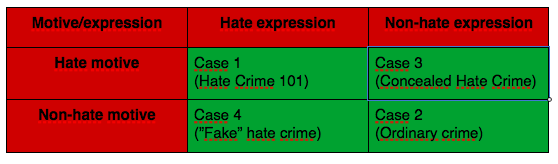
For illustration, consider the table below. On the one hand, we have the question of motive. Let’s simplify matters and say that an act is either motivated by hate or not motivated by hate. On the other hand, we have expression and again: hate expression or non-hate expression. In the table, we find two relatively easy cases, and two difficult ones.
The easy cases
1) Hate Crime 101 In the top left, we find a hate motived crime expressing hate. Painting a swastika on the wall of a Jewish cemetery, say. This is a clear cut case of a hate crime.
2) Ordinary crime In the bottom right, we find the non-hate motivated, non-hate expressing crime. This is not a hate crime. (There is an added dimension not considered here: whether the hate is perceived or not. This is independent of the other factors)
The difficult cases
3)”Concealed hate crime” In the top right, we have a case where I’m motivated by hate, and I select a victim representing the group I hate. But I make it look like an accident, or am persuasive in arguing that my motive is greed or something else. In this case we have the two normal conditions ”crime” plus ”hate motive”. What we don’t have is hate expression. This, of course, means that we have no evidence of a hate crime. But is it still one?
4)”Fake” hate crime In the bottom left, we find cases where the means used for the crime has all the hallmarks of a hate motivated attack, but the motive is something else. To create a diversion, say. Or, even more poignantly: my motive may be to cause as much harm as possible, and I’ve decided that a racist-looking attack is the best way to cause harm and societial unrest.
What matters, motive or expression?
Let’s concentrate on 4). 4) may seem just as bad as 1). There are two lines of reasoning behind that statement. First: if what makes hate crimes worse than other crimes is that they (tend to) cause more harm than other crimes, then 4) is clearly as bad as a ”genuine” hate crime. If the victim and the victimized group thinks it is a hate crime, the same sort of emotional pain, insecurity and suspicion arise. Second: if what makes a crime a hate crime is the motive expressed, rather than the actual motive, 4) is a hate crime, and thus, trivially, as bad as a hate crime.
Taking expression to be essential to hate crime, and thus treating 4) as an example, has certain benefits.
If we think that bringing motives into legislation messes things up, legally and evidence-wise, focusing on expression – by definition publicly available (although it might take som decoding) – is a good replacement. An improvement, even.
We have other options, however. 3) May be a hate crime, but not as bad as 1) and 4). 4) may be as bad as 1), but not a hate crime. Alternatively: if we think 1) is worse than 4) motive may make things even worse. If expressing hatred cause the extra harm, this is one aggrevating factor, but actual hate may be another. We then have three conceptually distinct versions of hate crime – mere expression, genuine expression, and concealment. We thus have the conceptual means to justify different punishments for each of these.
On the badness of motives
I mentioned two cases of ”fake” hate crime. First: I want to cause a diversion while I commit yet another crime, say, or I want something to keep the media attention away from other affairs for a while. This is sneeky, cynical even, but does not make that part of my criminal activity worse. But what if my motive is that I want to cause as much harm as possible? I don’t care about the victims race, I only care about them as ”vehicles of harm”. If I could find some other means of causing even greater harm, I would. This sort of sadistic, yet ”equal opportunity” motive seems on the face of it to be as bad as hate motive. If motives matters, then, and Hate Crime legislation suggest that it might, then we may have to open the door for other punishment enhancements. This, the critics argue, is a dangerous door to open. We may certainly make the moral case that certain motives are worse than others, but this may be one moral value that should not carry over into legislation.
Putting our focus on expression, rather than motive, fits the Hate Crime category into a classic conception of the law as dealing with what people do, rather than with what they think or feel.